
Short answer
Start two weeks out. Move bedtime earlier in small steps, put the fall's school hours and classes into one shared calendar, and decide who does each drop-off and pickup. Keep the first week light and watch for tiredness. In weeks two to four, start activities one at a time, fix what isn't working, and settle into a five-minute weekly check.
What to do two weeks before school starts
Two weeks out is when you fix the things that are hard to fix once school starts: sleep, paperwork and who's driving. Start moving bedtime earlier, finish the forms and the supply list, and sit down with your partner to write the fall's schedule in one place, with a name on every drop-off and pickup. Settle the driving first. It's the one that blows up in week one.
It's mid-August, the kids are going to bed at 10:00, the soccer registration closes Friday, and nobody has asked whether Grandma can still do Thursdays. That's normal. It's also exactly the list for this week.
- Start the sleep shift (details in the next section).
- Finish school forms, medical forms and the supply list.
- List every fall class: day, time, place and start date.
- Put school hours and classes into one calendar you and your partner both see.
- Put one parent's name on every drop-off and pickup. Our guide to splitting drop-offs and pickups has three patterns to choose from.
- Ask your backups (a grandparent, a neighbor) which days they can cover, and add them to the school's pickup list.
- Do a practice run of the school morning, at school time, with shoes.
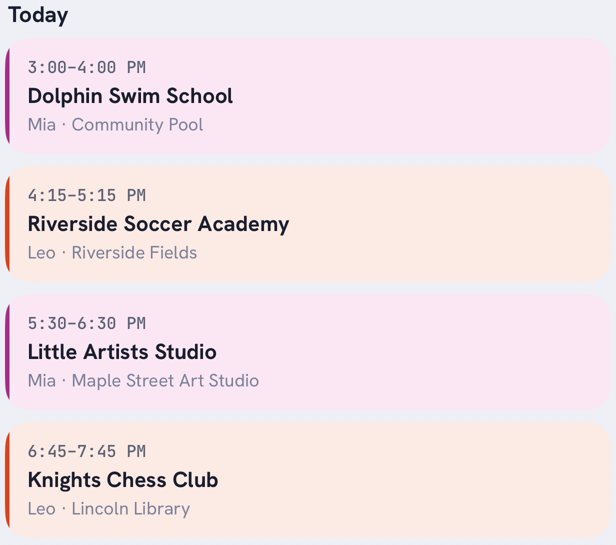
Steps three to five are where Kidbud fits, if you use it: enter each class once, put a name on every drop-off and pickup, and invite your spouse and the grandparents. Do it before the first week. During it, nobody has the patience.
What's a good back-to-school sleep schedule?
Pick the wake-up time school needs, count back the hours of sleep your child's age calls for, and that's bedtime. The CDC recommends 9 to 12 hours for kids aged 6 to 12 and 8 to 10 for teens. The American Academy of Pediatrics suggests easing into earlier bedtimes a week or two before school starts, rather than all at once the night before.
| Age | CDC recommended sleep per 24 hours | Bedtime for a 6:30 wake-up |
|---|---|---|
| Preschool, 3 to 5 | 10 to 13 hours, including naps | Depends on naps |
| School age, 6 to 12 | 9 to 12 hours | No later than 9:30 |
| Teen, 13 to 17 | 8 to 10 hours | No later than 10:30 |
How we'd do it: move bedtime and the morning alarm 15 minutes earlier every three or four days. Getting from 10:00 to 8:30 takes six steps. About three weeks. If you're starting with two, take bigger steps. (That pace is our judgment, not a medical rule.)
The AAP's HealthyChildren.org also recommends the same waking time on weekdays and weekends, and screens off at least an hour before bed. Its back-to-school advice suggests a calm, consistent bedtime routine: a bath, reading together, tucking in and saying goodnight.
How much does back to school cost per child?
Deloitte's 2025 back-to-school survey found US parents planned to spend about $570 per student on back-to-school shopping for kindergarten through 12th grade, and an average of $532 per child on extracurricular fees and equipment. Across the country, that shopping added up to $30.9 billion. Budget for both lines together, in August.
| What | Average (Deloitte, 2025) |
|---|---|
| Back-to-school shopping, per K to 12 student | About $570 |
| Extracurricular fees and equipment, per child | $532 |
| Total US K to 12 back-to-school spending | $30.9 billion |
Those are averages, and a travel soccer season alone can blow through the second line. Our guide to what kids' activities cost breaks the numbers down by sport and class.
What to do in the first week of school
Protect sleep and keep afternoons empty. The first week is tiring for kids even when it goes well, so we'd hold off on starting new activities, keep bedtime strict, and spend the energy on the morning routine and the school drop-off and pickup until they run without reminders. Don't read much into a meltdown or two by Thursday.
- Run the morning on clock times: wake, dressed, breakfast, teeth, shoes on, out. We lay it out minute by minute in how to get kids out the door on time.
- Pack backpacks and lay out clothes the night before.
- Weigh the backpack once. The AAP says it should never be more than 10% to 20% of your child's body weight.
- Read everything that comes home in the folder the same evening. Pickup changes and early-release days hide in there.
- Check that whoever has each drop-off and pickup actually knows it, the night before.
Weeks two to four: how to get back into a school routine
This is when the activities start and the real schedule shows up. Add classes one at a time rather than all on the same Monday, and watch how your kids cope. Hold a five-minute check with your partner every Sunday, look at the coming week, and fix clashes before they turn into 5:15 phone calls. If it still wobbles in week four, we'd change one thing at a time rather than tear it all up.
Things to look for by the end of the month:
- A child who's short on sleep most nights. Move bedtime, or drop something.
- Two classes that overlap in different places. That afternoon needs both parents, or a backup.
- One parent doing every pickup. Count the legs for a week and rebalance (in Kidbud's week view that takes about a minute).
- Homework getting squeezed out on activity days. Our after-school routine by age has a sample afternoon.
If the first one lasts more than a week, the fall is probably too full. That's a judgment call for each family, and we've written up how many activities is too many. Our own view: one activity per child on school nights in September is plenty.
How Kidbud helps you set up the fall
Kidbud is a shared family calendar built for kids' classes. You enter the fall's classes once, see them in day, week or month views filtered by child, and assign every drop-off and pickup to one person. The assigned driver gets a traffic-aware Leave Now reminder. Invite your spouse and the grandparents before week one, so the Thursday question gets answered in August.
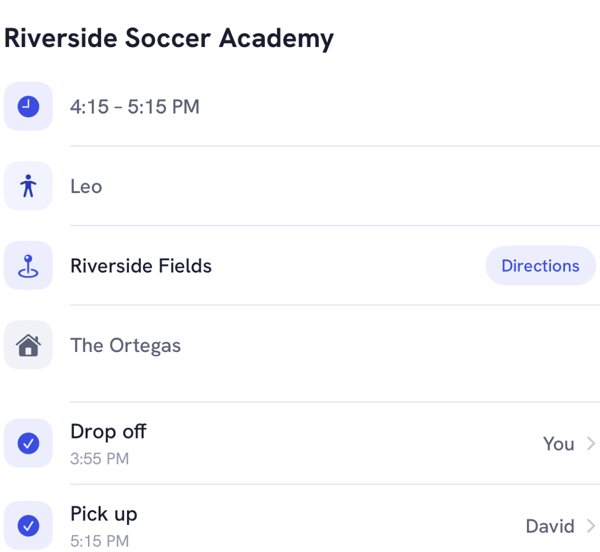
Its Discover tab can also suggest local classes that match each child's interests, which helps if you're still choosing in August. It doesn't import your school calendar from Google or Apple, and it has no supply lists or chores, so the paperwork checklist above stays on paper. It runs on iPhone and Android, and costs $59.99 a year or $12.99 a month, with one subscription covering everyone you invite.
Set up the fall schedule before week one
In Kidbud you enter every class once, put a name on each drop-off and pickup, and invite the grandparents.


Frequently asked questions
What should be on a back to school checklist for parents?
Bedtime moved earlier, school forms and supplies done, the fall's school times and classes in one shared calendar, a named driver for every drop-off and pickup, backup adults on the school's pickup list, and a short weekly check with your partner.
When should kids start a back to school sleep schedule?
A week or two before school starts, which is what the American Academy of Pediatrics suggests. We'd lean toward two weeks and move bedtime and wake-up about 15 minutes earlier every few days.
How do I get my kids back into a school routine?
Keep the first week simple, with the same wake-up time every day, an early bedtime and light afternoons. Add activities in weeks two to four, one at a time, once school itself feels normal.
What is a good back to school schedule for kids?
One that starts from the school bell and works backward: a fixed wake-up time, a timed morning, and a bedtime that allows 9 to 12 hours of sleep for kids aged 6 to 12, the range the CDC recommends.