
Short answer
Plan backward from the minute you need to arrive, not forward from wake-up. Put a time on each step of the morning, with a shoes-on time 10 minutes before you leave. Do every decision the night before, keep a packed go bag for each activity, and park everything that leaves the house at one spot by the door.
Why are we always late with kids?
Our guess is that most families plan a school morning from the wrong end. They know when school starts and roughly when everyone gets up, and hope the middle works out. It doesn't, because the middle is full of small transitions nobody budgeted for: finding the other shoe, a meltdown about socks, the permission slip that needs a signature. Planning backward makes those minutes visible.
It's 7:46. The car needs to leave at 7:50, one kid is dressed, the other is lying on the hall floor reading, and the soccer cleats are in the other car. None of those is a disaster. Together they're 12 minutes.
Afternoons are worse in one way. School mornings at least repeat. Activity days change: swim on Monday, soccer on Tuesday, art on Wednesday, each with its own bag, its own start time and its own drive. (Those afternoons are what we built Kidbud for. The mornings we mostly leave to you and a sheet on the fridge.)
How to plan a school morning backward from the bell
Start with the time your child must be at school, subtract the drive and a parking buffer to get your leave time, then work back step by step to a wake-up time. Give every step a clock time, not a duration. We think "teeth by 7:25" lands better with kids than "brush your teeth soon", and either way you can see exactly where the morning slipped.
Say the bell is at 8:10 and the drive takes 12 minutes. Swap in your own numbers.
| Time | Step | Notes |
|---|---|---|
| 6:45 | Wake up | Same time every day, weekends included, if you can stand it. |
| 6:50 | Get dressed | Clothes were laid out last night. |
| 7:05 | Breakfast | Twenty minutes, sitting down. |
| 7:25 | Teeth, hair, bathroom | The step that always runs over. |
| 7:40 | Shoes on, coats on, bags in hand | The real deadline. Announce it. |
| 7:50 | Leave | Arrive about 8:02, with a few minutes spare for the drop-off line. |
The 7:40 line matters most. We'd rather call shoes-on ten minutes early and stand around for four than call it at 7:48. If your kids are younger than six, add five minutes to every step and don't feel bad about it.
What to do the night before
Anything that involves a choice should happen the evening before. Pediatrician Cindy Gellner at University of Utah Health suggests laying out clothes and packing backpacks the night before, allowing extra time to wake up, and saving screens until after school. We'd add making lunches and signing anything in the folder while the kids are still awake to argue about it.
- Lay out tomorrow's clothes, down to socks.
- Pack the backpack and put it at the door, zipped.
- Check tomorrow's calendar for an activity, and put that go bag at the door too.
- Make lunches, or at least the parts that keep.
- Sign forms and put money in an envelope in the backpack.
Gellner also recommends double-checking supplies before you leave, including what's needed for extracurriculars. That's step three, done twelve hours earlier.
How much sleep do kids need for mornings to work?
School-age kids aged 6 to 12 need 9 to 12 hours of sleep a night, according to the CDC, and teens need 8 to 10. A morning plan can't fix a child who went to bed too late. Work bedtime out from your wake-up time: a 6:45 alarm and ten hours of sleep means lights out at 8:45.
| Age | Recommended sleep per 24 hours (CDC) | Bedtime for a 6:45 wake-up |
|---|---|---|
| Preschool, 3 to 5 | 10 to 13 hours, including naps | Depends on naps |
| School age, 6 to 12 | 9 to 12 hours | No later than 9:45 |
| Teen, 13 to 17 | 8 to 10 hours | No later than 10:45 |
The American Academy of Pediatrics, on its HealthyChildren.org site, recommends the same waking time on weekdays and weekends, and turning off all screens at least an hour before bed. The weekend part is the hard sell. It's also the part that makes Monday at 6:45 feel less like an ambush.
How to get out the door on time for after-school activities
Give each activity its own go bag that lives packed, and set a shoes-on time 20 minutes before you need to leave. Afternoons fail differently from mornings: the kit is in the wash, a snack hasn't happened, and nobody's sure what time the class starts. A bag that's always packed won't settle the start-time question, but it does end the hunt for kit.
Unpack the bag the moment you get home, wash what needs washing, and repack it that night. A go bag for each activity might hold:
| Activity | In the bag |
|---|---|
| Swim | Suit, towel, goggles, cap, a plastic bag for the wet things, a comb |
| Soccer | Cleats, shin guards, socks, water bottle, the team shirt |
| Dance or gymnastics | Leotard, the right shoes, hair ties, water bottle |
| Music lesson | Instrument, the practice book, the lesson notebook |
Put a snack in every bag. A hungry eight-year-old at 4:00 is the slowest person in your house.
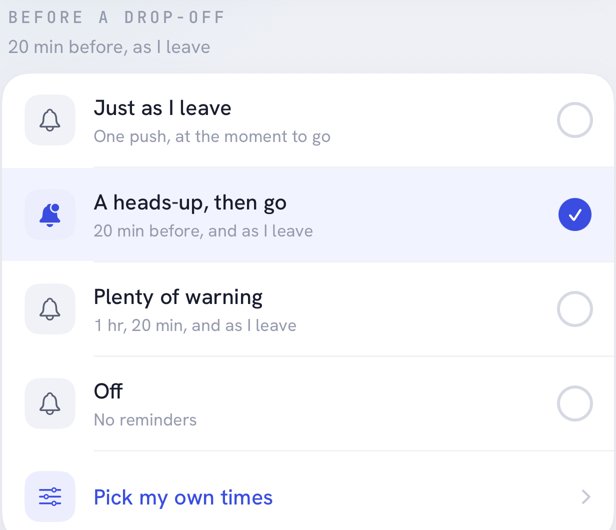
We put this exact nudge into Kidbud as a setting ("a heads-up, then go"). Whoever is assigned Tuesday's soccer drop-off hears from their phone at shoes-on time and again when it's actually time to go, timed against current traffic.
Set up a launch pad by the door
A launch pad is one spot by the door where everything leaving the house waits: backpacks, go bags, shoes, keys and anything that needs to go back to school. If it isn't on the launch pad, it isn't coming. It costs a few hooks and a bin, and it ends the morning hunt through three rooms.
- One hook per child, low enough for them to reach.
- A shoe tray right underneath.
- A basket for go bags, with a printed checklist taped to each bag.
- A tray for keys and anything that needs signing.
Some families hang a big calendar here too. We think a paper calendar and a phone calendar end up disagreeing within a month, but if yours sticks, keep it. Our after-school routine by age covers what happens once everyone is home again.
How Kidbud helps with activity afternoons
Kidbud is a shared family calendar for your kids' classes, with every drop-off and pickup assigned to one parent. The assigned driver gets a traffic-aware Leave Now reminder, and you choose the timing separately for drop-offs and pickups. Pick "a heads-up, then go" and you get a 20-minute shoes-on warning plus a nudge as you leave.
Now the limits. It's built for classes and activities, so the school-morning timeline above is still a sheet on the fridge. It has no checklists or chores, so the go-bag list stays on the bag. It doesn't import from Google or Apple calendars. It works on iPhone and Android, you can invite your spouse or the grandparents, and it's $59.99 a year or $12.99 a month for the whole family.
For working out the drive itself, see what time to leave for drop-off and pickup.
Get a shoes-on warning before every drop-off
Kidbud sends the assigned driver a heads-up 20 minutes ahead, then tells them when to leave.


Frequently asked questions
How can I get my kids ready for school faster?
Move every decision to the night before: clothes picked, backpack packed and by the door, lunch made. Then give the morning a fixed order with a time on each step, and set a shoes-on time 10 minutes before you need to leave.
Why are we always late with kids?
Usually because the plan counts from the bell instead of from the door, and leaves no room for the lost shoe. Most families also skip the transition time, the minutes it takes a child to stop one thing and start the next.
How do I stop running late with kids?
Work backward from the time you must arrive, include the drive at that hour, and pick a shoes-on time 10 to 20 minutes before leaving. Keep everything that leaves the house in one spot by the door.
What should be on an after school activity departure checklist?
The activity bag, a water bottle, a snack, the right shoes for the class, any forms or fees due, and the child. Keep one checklist per activity on the bag itself, so whoever is driving can check it in ten seconds.