
Short answer
Work backwards from the time you need to be there: leave time = arrival time − drive time at that hour − parking and walking − a traffic cushion. For a drop-off, the arrival time is about 10 minutes before class starts. For a pickup, it's the minute class ends. Use the drive time for that hour, not your usual one, plus a 10 to 20% cushion.
How do you work out when to leave?
Start from the time you have to be there and subtract three things: the drive at that hour, a few minutes to park and walk in, and a cushion of 10 to 20% of the drive. The drop-off and the pickup for the same class usually come out to different answers, because the traffic and the arrival rule are different at each end.
A made-up example. Say Leo's soccer runs 4:15 to 5:15 at a field 14 minutes away.
| Step | Drop-off | Pickup |
|---|---|---|
| Be there by | 4:05 (10 min early) | 5:15 (class ends) |
| Drive time at that hour | 14 min | 22 min (rush hour) |
| Parking and walking | 5 min | 5 min |
| Traffic cushion (about 15%) | 2 min | 3 min |
| Leave at | 3:44 | 4:45 |
Notice the pickup leave time isn't "class end minus 14 minutes". The same road is slower at 5pm. That's how a reminder you set once in September quietly goes stale by October. (The 15% cushion is our rule of thumb, by the way, not a traffic-engineering number. We haven't found a good published figure, so adjust it once you've done the drive a few times.)
Why do drop-off and pickup need different leave times?
Because the two ends of a class aren't symmetrical. At drop-off you want a few minutes of slack before class so your kid can change and settle, while at pickup the deadline is the minute class ends and someone is waiting with your child. The traffic is usually different too, and so, often, is the parent behind the wheel.
- Drop-off has a buffer before class. Kids need time to change, find cleats and get to the coach. Arriving as class starts usually means arriving late.
- Pickup has a hard edge. Coaches and teachers wait with your child, and many programs charge a late pickup fee. Check your program's policy so you know what's at stake.
- Traffic is different at each end. A drop-off at 3:45 and a pickup at 5:15 sit in different traffic, even on the same road.
- The driver may be different. If you split drop-offs and pickups with your spouse, each of you leaves from a different place.
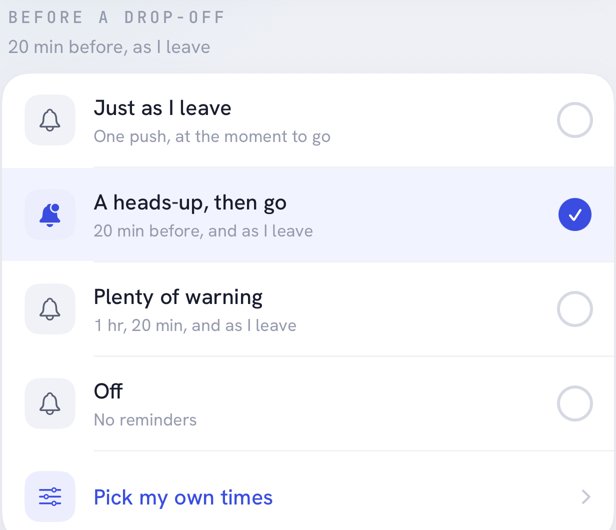
We split the two timings in Kidbud for this reason. Before drop-offs you might want the 20-minute heads-up, since that's when shoes and water bottles go missing. Before pickups, a nudge just as you need to leave is plenty. Your call.
Why do fixed phone alarms stop working?
A phone alarm at 3:40 every Tuesday works until traffic changes, the class moves, or the other parent takes the drive. Then it rings on the wrong phone. (This is the exact problem we built Kidbud's Leave Now reminders for, so weigh our bias accordingly.) It's a lot of driving to leave to an alarm: in a 2021 HopSkipDrive survey, nearly 40% of parents said they spend two to four hours a week driving their kids.
What is a traffic-aware leave reminder?
A traffic-aware leave reminder is an alert that calculates the drive from where you are to where you need to be, using current traffic, and tells you when to leave so you arrive on time. Unlike a fixed alarm, the alert time moves when traffic gets worse or better.
Phone map apps can do a version of this for a single trip you set up. For after-school driving we think the useful version also has to know whether the trip is a drop-off or a pickup, and which parent is driving it, otherwise the alert lands on whoever happened to create the event.
What if two kids finish at the same time?
Then the leave-time maths stops mattering, because one parent can't be in two places at 5:15. Spot these clashes on Sunday, not at 5:05. The fixes are dull but they work: split the two pickups between two drivers, ask one coach if your kid can wait ten minutes, or move one class to another day next term.
Say Leo's soccer ends at 5:15 on one side of town and Mia's swim lets out at 5:15 on the other. A made-up week, but a very ordinary one. A few ways families handle it:
- One parent takes each pickup. Simple if both of you finish work by 4:45, impossible if not.
- The closer child waits. Most coaches will keep an eye on a kid for ten minutes if you ask in advance. Ask; don't assume.
- A backup adult takes one leg. A grandparent, a neighbor, another parent from the team.
- Change the schedule. If the clash is every single week, it's a schedule problem, not a driving problem.
(Kidbud shows both pickups on the same day view, each with its driver's name, so a clash with one name on both legs is hard to miss. It won't solve the clash for you. Nothing will.)
How Kidbud's Leave Now reminders work
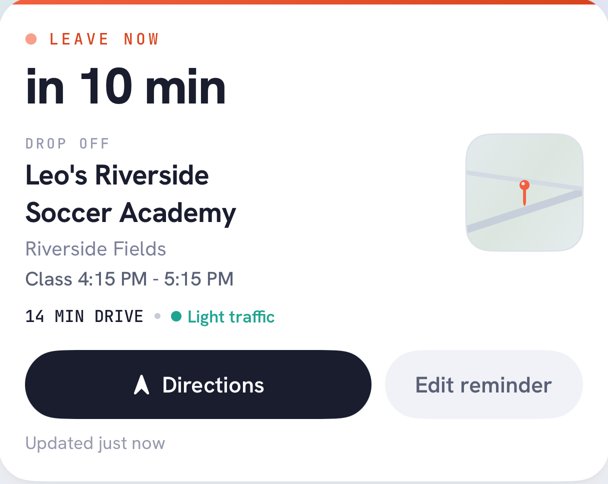
Kidbud is a family calendar app built around drop-offs and pickups. For each class it knows the place and the time, and which parent is driving each leg. It checks live traffic and sends only that driver a Leave Now alert. You pick how much warning you want, separately for drop-offs and for pickups: just as you leave, a 20-minute heads-up, or your own times.
Know when to leave, every time
Traffic-aware reminders for every drop-off and pickup.


Frequently asked questions
How early should I arrive for a kids' class drop-off?
About 10 minutes before class starts is a good default, more for a first session or anything your kid has to change for. That gives time to park, walk in and hand over.
Is there an app that reminds you when to leave for drop-off and pickup?
Yes. Kidbud sends a Leave Now reminder before every drop-off and pickup on your family calendar, timed with live traffic and sent to whichever parent is driving that leg.
How much traffic buffer should I add?
Add 10 to 20% of the drive time on top of the drive itself, plus a few minutes for parking. Use more on routes past schools at dismissal time.
What if two kids finish at the same time in different places?
One parent can't be in two places, so split the legs between two drivers, ask the coach whether one child can wait ten minutes, or move one class. Whatever you pick, decide it on Sunday, not at 5:05.