
Short answer
There's no official number. A sensible starting point is one or two activities per child per season, with at least a few afternoons a week left unscheduled for free play, which the American Academy of Pediatrics says is essential to development. Add more only if your child still has energy, sleeps well and enjoys going, and if your family can cover every drop-off and pickup without strain.
What is typical?
Most school-age kids do something after school. US Census Bureau data shows that 57% of children aged 6 to 17 take part in at least one extracurricular activity: 42% play sports, 30% take lessons and 28% are in clubs. The data is from 2014, so it's old. We haven't found a newer national count.
In a Pew Research Center survey of parents of 6 to 17 year olds, 73% said their children had played sports in the past year and 54% said they had taken music, dance or art lessons. Most parents (72%) said their child's schedule was about right, and 15% said it was too hectic.
What does the research say about free time?
The AAP's clinical report "The Power of Play" (Pediatrics, 2018) describes play as essential to children's development, building executive function and helping buffer stress, and encourages pediatricians to "prescribe" play. Organized activities aren't play in this sense. A child with an activity every afternoon has no time left for it.
So the number we'd actually watch is free afternoons. Activities are just the thing that eats them.
How many activities should a child do at each age?
These aren't research thresholds, and we don't know of any study that sets one. They're our default, based on how much a typical child can handle and, honestly, how much driving each extra class creates. Adjust from there. A kid who flops on the couch every day after school probably needs a lighter row than the table says.
| Age | Activities per season | Keep free |
|---|---|---|
| 4 to 6 | 1, short sessions | Most afternoons |
| 7 to 10 | 1 or 2 | At least 2 or 3 afternoons |
| 11 to 13 | 2, maybe 3 if one is light | At least 2 afternoons |
| 14 and up | Led by the teen's own interests | Enough for homework and sleep |
Mississippi State University Extension suggests a similar habit: limit activities to one per season and keep everything on a shared family calendar so the load is visible.
What are the signs a child is overscheduled?
The clearest signs are a child who's tired and cranky most days, homework pushed late into the evening, and dread about an activity they used to love. Watch the parents too. If the logistics are wearing you down, the schedule is too full even when your child seems fine. One bad week means nothing. Three in a row is worth a talk.
- Regularly tired, irritable or getting sick more often
- Homework done late at night or in the car
- Dreads going to an activity they used to enjoy
- No unstructured time on most weekdays
- Family dinners have become rare
- Parents are stressed by the logistics, not just the child
A quick reality check: filter the week by one child (Kidbud's calendar does this in a tap, a paper planner works too) and count the afternoons with nothing on them. Fewer than two, and it's probably too much.
What does each activity add to the week?
Every weekly activity adds two drives: a drop-off and a pickup. Two kids with two activities each means eight trips a week before games, rehearsals and birthday parties. The money adds up too: the Aspen Institute's Project Play found families spend on average just over $1,000 a year on a child's primary sport, with travel the biggest single cost.
Before saying yes to a new activity, count the legs it adds and decide who is driving each one. If nobody can, that's your answer.
Say your son's new chess club ends at 5:30 on Wednesday, the same minute his sister's swim class lets out across town. Two pickups, one driver. (Kidbud's week view shows that kind of clash plainly: every class lists its drop-off and its pickup with a parent's name on each, so a leg with no name is easy to spot.)
How do you cut back without making it a big deal?
Finish the season or the paid block if you can, then simply don't re-enroll. Kids handle "we're taking a break from swim this winter" far better than a mid-season exit, and you keep the door open. The exception is a child who's genuinely miserable or exhausted. Then stopping now is fine, and you can say so plainly.
A few things that make the conversation easier:
- Let your child pick what stays. Keeping one thing they chose beats keeping three you chose.
- Name the reason honestly. "Tuesdays are too packed" is true and isn't about them.
- Cut by time, not by count. The activity that meets twice a week and needs a 25-minute drive costs more of the week than the one round the corner on Saturdays.
- Put the freed afternoon somewhere visible as free time, so it doesn't quietly fill up again.
We'd also check what you've already paid for. Plenty of programs bill by term, so the cheapest moment to stop is usually the end of one. (That's an opinion, not a rule. If the season is wrecking everyone's sleep, the money's already spent either way.)
One more thing worth saying out loud: dropping an activity isn't failing at it. Most kids cycle through a few before one sticks. Ours to manage is the calendar, not their identity.
Keep it visible with Kidbud
Kidbud won't tell you how many activities is right. It's a shared family calendar for every child's classes, with each drop-off and pickup assigned to one parent and a traffic-aware Leave Now reminder for whoever's driving. Where it helps here is the honest count: with every class and its two drives on one screen, an overfull week is hard to miss.
It doesn't do chores or lists, and it doesn't import from Google or Apple calendars, so classes go in by hand. It's $59.99 a year or $12.99 a month on iPhone and Android, and one subscription covers everyone in the family.
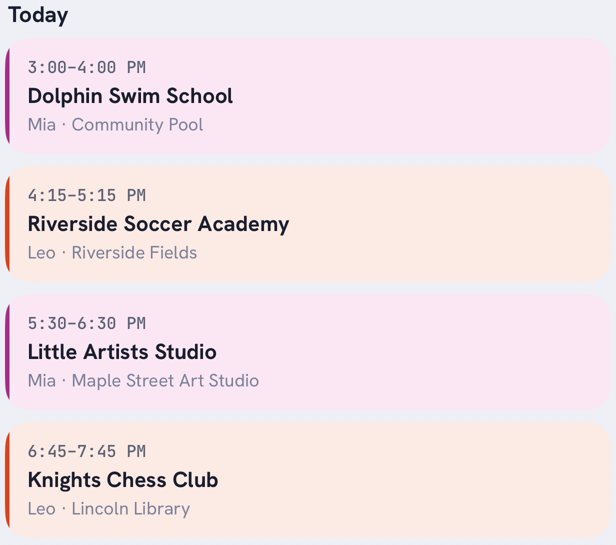
See every kid's week at a glance
One calendar for every class, drop-off and pickup.


Frequently asked questions
Is three activities too many for a child?
It can be. Three light ones, say a Saturday swim class, a 45-minute art class and a weekly chess club, can be fine. Three that each meet twice a week usually aren't, because that's six sessions in a five-day school week.
Should kids do one sport or several?
For younger children, trying different activities across seasons is common, and it keeps any one sport from taking over the week. Older kids often narrow down to what they enjoy most.
How do I manage several kids' activities?
Put every class in one shared calendar, give every drop-off and pickup a named driver, and check the coming week together each Sunday.
Should I let my child quit an activity mid-season?
Usually we'd finish the season or paid block and then not re-enroll. If your child is genuinely miserable, exhausted or anxious about going, stopping now is fine. Let them choose what stays, and give the honest reason.
Sources
- US Census Bureau, A Child's Day, 2018 release (2014 data)
- Pew Research Center, Parenting in America: children's extracurricular activities, 2015
- American Academy of Pediatrics, The Power of Play, Pediatrics 2018
- Aspen Institute Project Play, youth sports costs
- Mississippi State University Extension, tips for managing extracurricular activities