
Short answer
Pick one rotation pattern and write it down. Most two-parent families use one of three: fixed legs (one parent does every drop-off, the other every pickup), split days (each parent owns certain weekdays), or split activities (each parent owns certain classes). Put a named driver on every drop-off and pickup in a shared calendar, and check the coming week together once, on Sunday.
Why splitting the driving goes wrong
Most couples don't have a plan. They have a group text. Every afternoon somebody asks "are you getting her?", somebody answers late, and sooner or later a drop-off or pickup ends with both parents in the school parking lot. Or neither. The fix is boring: decide the split once, write it down, and stop renegotiating it every day.
The cost is real. In a 2025 AP-NORC poll of US parents run with HopSkipDrive, about a third said they had missed work because of school transportation, and mothers were more likely than fathers to report a hit to their careers (55% versus 45%). An earlier HopSkipDrive survey found that nearly 40% of parents spend two to four hours a week driving their kids.
A written split fixes most of this, because "who's driving?" gets answered once a week instead of once a day. (That weekly answer is what we built Kidbud around: every drop-off and pickup in it carries one parent's name.)
The three rotation patterns
Most two-parent families settle into one of three patterns. Fixed legs: one parent does every drop-off and the other every pickup. Split days: each parent owns certain weekdays. Split activities: each parent owns certain classes, both ways. Transportation researchers who study dual-earner households find that parents usually take turns rather than share every trip, and these are the shapes the turn-taking tends to take.
| Pattern | How it works | Best for | Watch out for |
|---|---|---|---|
| Fixed legs | One parent does every drop-off, the other does every pickup. | One parent starts work late, the other finishes early. | The pickup parent carries every late class and every evening. |
| Split days | Each parent owns certain weekdays, for example Monday to Wednesday and Thursday to Friday. | Parents with office days and home days. | A busy day for one kid can land on the same parent every week. |
| Split activities | Each parent owns certain classes, drop-off and pickup both. | Several kids at different venues on the same afternoon. | Clashes when two owned classes overlap. |
If we had to pick one for a family with two kids in classes, we'd start with split activities. Nobody has to remember what day it is, because swim is always the same parent. That's a preference, though. We don't know of good data on which pattern couples actually stick with.
How to choose your pattern
Start with whose working hours are least flexible: that parent takes the leg that fits around them. Next, look at which way each commute runs, and give each class to the parent who drives past it anyway. Last, find the afternoons where two classes overlap in different places. Those days need split activities, whatever pattern you use for the rest of the week.
Say Sarah finishes work at 3:30 and David's office is ten minutes from the pool and the soccer field. Sarah takes the afternoon drop-offs, David collects on his way home, and Thursday's 6:45 chess is all David, both ways, because Sarah has bedtime with the toddler. (Sarah and David are made up. The shape of their week probably isn't.)
Mixed patterns are normal. Plenty of families run fixed legs on school days and split activities on Saturdays.
Write down a named driver for every leg
Every drop-off and every pickup gets one parent's name on it. "Us" doesn't count, and neither does "whoever's free". A name means one person owns that leg, gets the reminder, and has to arrange a swap if their meeting runs over. This is Sarah and David's week: fixed legs, with Thursday and Saturday as the exceptions.
| Day | Class | Drop-off | Pickup |
|---|---|---|---|
| Monday | Swim, 3:00 to 4:00 | Sarah | David |
| Tuesday | Soccer, 4:15 to 5:15 | Sarah | David |
| Wednesday | Art, 5:30 to 6:30 | Sarah | David |
| Thursday | Chess, 6:45 to 7:45 | David | David |
| Saturday | Soccer match, 9:00 | Sarah | Sarah |
Keep it somewhere you both see without asking. A shared family calendar beats a note on the fridge, because the plan and the class times live in the same place (our guide to sharing a calendar with your spouse covers the iPhone and Android setup).
In Kidbud, that table is simply the week view. Tap Tuesday's soccer, set the drop-off to Sarah and the pickup to David, and David is the one who gets the leave alert at 4:50, not Sarah.
Handle the exceptions before they happen
Agree on the exceptions now, while nobody's late. Four rules cover most of what goes wrong: how a swap works, who the backup is, when each driver actually leaves, and a short weekly check. Settling them on a calm Sunday is far easier than settling them by text at 4:40, with a child waiting outside the gym.
- The swap rule. Either parent can ask for a swap, but it's only real once the other parent changes it in the calendar. A thumbs-up emoji is not a swap.
- A named backup. Agree on one person, a grandparent or a neighbor, who covers when neither of you can.
- Leave times. Each driver needs to know when to leave, which is a different number from when class starts. Traffic at 4:30 isn't traffic at 2:30. We worked through the math in what time to leave for drop-off and pickup.
- The Sunday check. Five minutes on Sunday evening to look at the week and fix clashes. That's it.
How Kidbud does this for you
Kidbud is a family calendar app built around this exact job, and not much else. Every class has a drop-off and a pickup, and each one is assigned to a parent. The assigned driver gets a traffic-aware Leave Now reminder, timed separately for drop-offs and pickups, and the other parent can see the leg is covered without asking.
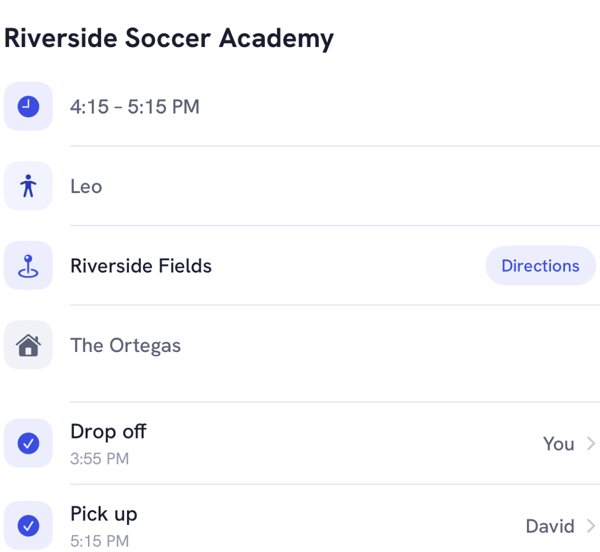
What it won't do: it doesn't sync with Google or Apple calendars, and it doesn't run carpools with other families. A grandparent or sitter who covers Thursdays can be invited into your family, though. It works on iPhone and Android, so a mixed couple shares one plan, and it's a subscription, $59.99 a year or $12.99 a month, with one subscription covering everyone you invite.
Stop texting "are you getting her?"
Kidbud assigns every drop-off and pickup and tells the driver when to leave.


Frequently asked questions
Who should do school drop-off, mom or dad?
Whoever has the less flexible start time should usually take the leg that fits around it. There is no right answer by gender. What matters is that the split is written down and roughly fair over a whole week, including evening classes.
What is a fair way to split drop-offs and pickups?
Count legs, not days. Add up every drop-off and pickup in a normal week and aim for each parent to own about half, adjusted for whose commute passes which venue.
What if our schedules change every week?
Use split days and redo the plan at a five-minute Sunday check. A shared calendar with a named driver per leg makes the weekly reset quick.