
Short answer
Most US parents spend somewhere between $500 and $750 a year per child on extracurriculars. Deloitte's 2025 survey puts planned spending at $532 per child, and a 2023 LendingTree survey found $731. Sports cost more: the Aspen Institute found families spent $1,016 on a child's main sport in 2024, and nearly $1,500 across all sports.
What is the average cost of extracurricular activities per child?
The two most recent national surveys land at $532 and $731 per child per year. Deloitte's 2025 back-to-school survey found that nine in 10 parents plan to enroll their kids in extracurriculars, at an average of $532 per child on fees and equipment, down $50 from the year before. LendingTree's 2023 survey of parents with kids in activities put it at $731.
| Survey | What it measured | Per child, per year |
|---|---|---|
| Deloitte, 2025 | Planned extracurricular fees and equipment | $532 |
| LendingTree, 2023 | Spending by parents whose kids do activities | $731 |
| Aspen Institute Project Play, 2024 spending | A child's primary sport only | $1,016 |
The $200 gap comes down mostly to who got asked and what counted: Deloitte asked about plans, LendingTree asked parents already paying. Our read, for what it's worth: if your child does one or two non-travel activities, budget around $600 and you won't be far off.
How much does youth sports cost?
A lot more than the averages above. The Aspen Institute's Project Play survey found the average family spent $1,016 on a child's primary sport in 2024, up 46% since 2019. Add a second sport (about $475 on average) and one child's sports cost nearly $1,500 a year. The survey points to bigger bills for team registration, travel, private coaching and camps.
Some sports climbed much faster than others between 2019 and 2024:
| Sport | Increase in family spending, 2019 to 2024 |
|---|---|
| Basketball | 105% |
| Soccer | 69% |
| Baseball | 68% (and the most expensive sport overall in 2024) |
We'd love to give you a clean per-class price for piano, ballet or art too. We couldn't find a national survey we trust that breaks those out, so we're not going to make one up. Call two local studios and ask for the full-term price including registration and recital or materials fees, which is usually where the surprise is.
Why do some families spend so much more?
Geography and income both move the number a lot. Project Play found urban parents spent $1,628 on a child's sports, suburban parents $1,552 and rural parents $924. Households earning $100,000 or more spent $1,471 more a year on a child's primary sport than households under $50,000.
Then there's travel. A rec league at the park five minutes away and a club team with weekend tournaments two states over are different planets, budget-wise (hotel, gas, the team dinner at a chain restaurant nobody picked).
None of this is abstract. In LendingTree's survey, 42% of parents with kids in activities said they'd taken on debt to pay for them, and 62% said they'd been stressed about the cost.
What does an activity cost beyond the fee?
Time, mostly, and gas. Every weekly class adds a drop-off and a pickup, so two classes a week means four extra trips, often at 4:15 when one parent is still at work. Then there's gear that gets outgrown by spring, uniforms, picture day, end-of-season gifts for the coach and the snack rotation.
Say your daughter does swim on Mondays and soccer on Thursdays. That's about eight sessions a month, each with its own drop-off and pickup, so roughly 30 sessions and 60-odd trips over a four-month term. Nobody counts these when they sign up. (We built Kidbud partly so that count stops being invisible: once every class sits on one calendar with a named driver, you can see whose week is heavier.) Our guide on how many extracurricular activities a child should do looks at that side of the trade-off.
How do you budget for kids' activities?
Start from a yearly number per child, then fit activities into it, not the other way round. Write down every cost for each activity, including registration, gear, travel and the season-end extras, and add it up before you sign up. Leave about 10% spare for the things nobody mentions in the welcome email.
- Pick a yearly ceiling per child. The survey averages ($532 to $731) are a sane starting point for non-travel activities.
- Price each activity for a full year: registration, monthly fees, uniform, gear, tournaments, camps and the end-of-year show.
- Count the weekly drop-offs and pickups each one adds, and who'd cover them. If nobody can do the Wednesday 5:30 pickup, the activity doesn't fit, whatever it costs. (In Kidbud you could invite a grandparent and assign that pickup to them, and the leave reminder goes to their phone.)
- Ask about sibling discounts, payment plans and scholarships. Plenty of programs have them and never put them on the flyer.
- Buy used gear for anything a child will outgrow in a season. Cleats, obviously. Shin guards too.
- Review in January and again before fall sign-ups, and drop whatever your kid has quietly stopped enjoying. This is the step we'd least want you to skip, because a paid-up class nobody likes is the most expensive kind.
For summer, our summer camp cost guide has the weekly numbers.
Where Kidbud helps
Kidbud won't lower your registration fees, and we're not going to pretend a calendar app saves you money. It helps with the time cost, which is easier to fix once both parents can see it. Every child's classes go on one family calendar with day, week and month views and a filter by child, and each drop-off and pickup is assigned to one parent.
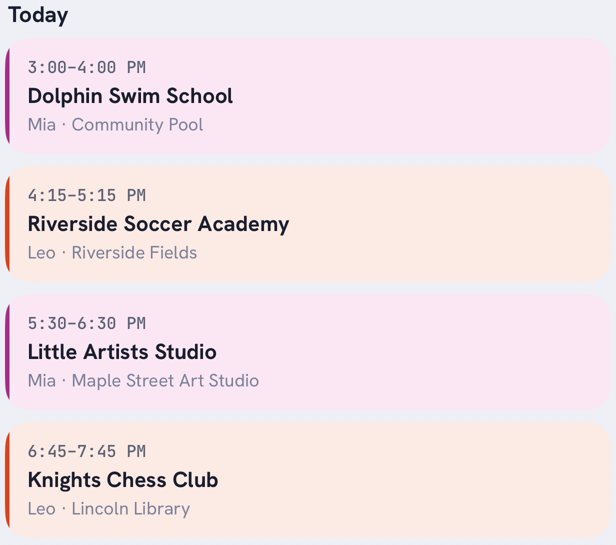
The assigned driver gets a traffic-aware Leave Now reminder, timed the way you choose. You can invite grandparents or a sitter to cover a leg. Kidbud also has Discover, which suggests local classes matched to each child's interests and adds one to the calendar (check the price with the studio first; we don't know it better than they do). It's $59.99 a year or $12.99 a month for the whole family.
See what each activity really costs in drop-offs and pickups
Put every class on one calendar, with a named driver for each trip.


Frequently asked questions
What is the average cost of kids activities per child?
Recent surveys put it between $532 and $731 per child per year. Deloitte's 2025 survey found $532 in planned fees and equipment, and LendingTree's 2023 survey found $731. A single sport usually costs more, with the Aspen Institute reporting $1,016 for a child's main sport in 2024.
How much do parents spend on extracurricular activities in total?
Two things drive it: how many kids you have and what they do. Per child, surveys land between $532 and $731 a year. For sports, the Aspen Institute found nearly $1,500 a year across all of one child's sports, and urban families spent $1,628 against $924 for rural families.
Do parents go into debt for kids' activities?
Many do. In LendingTree's 2023 survey, 42% of parents with kids in extracurriculars said they had taken on debt to pay for them, and 62% said paying for activities had stressed them out.
How do you budget for kids activities?
Set a yearly ceiling per child, price each activity for the full year including gear and travel, and add about 10% for extras. Count the weekly drop-offs and pickups each activity adds too, because an activity nobody can drive to doesn't fit.