
Short answer
Most kids are ready for simple organized soccer around age 6. The American Academy of Pediatrics says that by 6 most children have the basic motor skills for simple organized sports, and it lists soccer among good choices for ages 6 to 9. Younger kids can play too, as long as it's running and kicking with no scores. Keep it fun, and don't specialize early.
What age does the AAP say kids can start soccer?
Around 6. The AAP says that by age 6 most children have the basic motor skills for simple organized sports, and it names soccer in its list for ages 6 to 9, next to running, swimming, baseball, tennis, gymnastics, martial arts and skiing. Before 6, it says most children don't have those skills yet, and that competition should be avoided.
A soccer game for 4-year-olds mostly looks like a swarm. Eight kids chase one ball, and one sits down to pick clover. That's normal, and it's why the AAP's age bands are a better guide than a club's minimum age.
| Age | What the AAP suggests | What that looks like for soccer |
|---|---|---|
| 2 to 5 | Running, swimming, tumbling, throwing and catching. Avoid competition. | Kicking a ball in the park, or a short skills class with no scores |
| 6 to 9 | Simple organized sports with flexible rules, focused on learning skills rather than winning | A first recreational league |
| 10 to 12 | Sports with complex motor skills, teamwork and strategy, still focused on skills, fun and participation | Positions, tactics, and maybe tryouts for a more serious team |
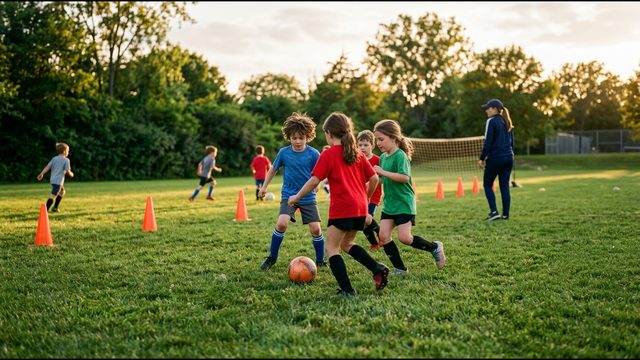
Can kids younger than 6 play soccer?
Yes, as play. If a local club runs a class for 3- and 4-year-olds, that's fine as long as the class is about running, kicking and laughing. The AAP's advice for ages 2 to 5 is to focus on running, swimming, tumbling, throwing and catching, and to avoid competition. So we'd skip anything that keeps score, ranks kids or runs tryouts at this age.
A kickabout in the park on Sunday does most of the same job, and costs nothing but your time. Whether starting at 4 instead of 6 makes a better player at 12, we honestly don't know. We haven't found good data either way, and we'd be wary of any club that claims it does.
Where starting young actually costs you is the calendar. A 4-year-old's class at 5:15 on a Tuesday is one more drop-off and pickup in a week that might already have a sibling's swim lesson at 5:30, two miles the other way. (Lining up drives like those is the problem we built Kidbud around, for what it's worth.)
When is a child ready for team sports?
Treat 6 as a rough guide. In our view a child is ready when they can follow a simple instruction from a coach, wait their turn, lose the ball without a meltdown, and ask to go back next week. The AAP's own test for a good program is simple: the children are having fun. If your 6-year-old dreads Saturday mornings, waiting a season is fine.
Signs we'd watch for in the first few weeks:
- They talk about practice afterward, even just to complain about the drills.
- They can stay with the group for most of a session.
- They aren't wiped out for the rest of the evening.
- They still want to kick a ball at home.
If most of those are missing, that tells you about this season and this kid's mood, and very little about their future in sports. Try again next fall. Or try swimming.
Should kids specialize in one sport?
Not early. The AAP warns against early specialization in a single sport, intensive training and year-round training because of the risk of injury and burnout. Its parent guidance says kids thrive when they try many different activities before puberty, and are less likely to lose interest or drop out when they play more than one sport. Soccer in fall and something else in spring is a good shape.
The AAP's rules of thumb are easy to check against a team schedule:
| AAP guideline | What it means for a soccer family |
|---|---|
| Kids should not train more hours each week than their age | A 9-year-old tops out at 9 hours a week, games included |
| 1 to 2 days of rest every week | No soccer at all on at least one day |
| At least 2 to 3 months off a year, which can be split into 1-month breaks | A real off-season, not a winter futsal league straight after fall |
| Many organizations advocate waiting until 10 to 12 to start heading the ball | Ask the club when heading starts in practice |
There's a sobering number on the AAP's burnout page too: nearly 70% of kids across the US drop their favorite sport before age 13. We read that as a good reason not to push harder at 8.
How much does youth soccer cost?
Quite a bit more than it did five years ago. In the Aspen Institute's Project Play survey of 1,848 sports parents, families whose child's main sport was soccer spent an average of $910 on it in 2024, up from $537 in 2019. Across all sports, the average family spent $1,016 on a child's primary sport, 46% more than in 2019, which is about double general inflation over the same years.
| Sport | Average family spending, 2019 | Average family spending, 2024 |
|---|---|---|
| Baseball | $660 | $1,113 |
| Soccer | $537 | $910 |
| Basketball | $427 | $876 |
Those averages cover kids aged 6 to 18, travel teams included. Project Play names team registration, travel and lodging for non-local play, and camps and private instruction as the biggest costs. A first recreational season for a 6-year-old avoids most of those, so ask your local club for its actual fee. Our guide to what kids' activities cost puts soccer next to other sports.
How much time does a first soccer season take?
More driving than you'd guess. Say your league runs one weekday practice and a Saturday game. That's four trips a week, a drop-off and a pickup each time, and someone has to remember the shin guards (HealthyChildren lists properly fitting shin guards as required gear). With two kids on different teams, it's eight trips before anything else in the week.
Decide who owns each leg before the first practice. The parking lot at 5:58, with the cleats in the other car, is a bad place to work it out. Our guide to splitting drop-offs and pickups walks through the patterns couples use.
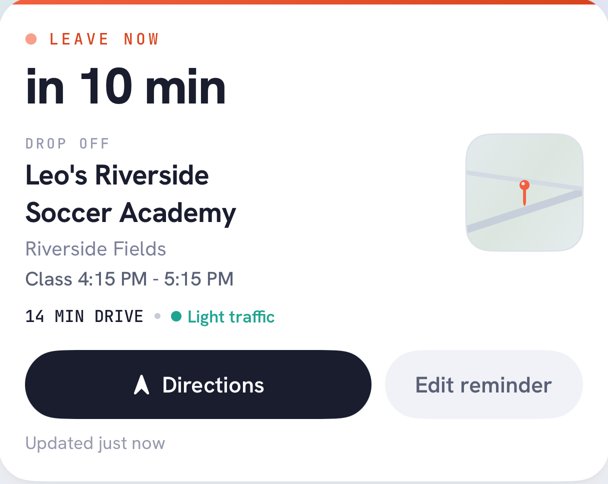
In Kidbud you'd put practices and games on the family calendar and give Tuesday's pickup to your partner. Then the Leave Now reminder buzzes their phone instead of yours.
How Kidbud helps with a soccer season
Kidbud won't pick a club, and it doesn't arrange carpools with other soccer families. It handles your own family's side: practices and games on one shared calendar with a filter by child, a named parent for every drop-off and pickup, and traffic-aware Leave Now reminders for whoever is driving. Grandparents or a sitter can be invited to see the same plan.
If you haven't found a program yet, Discover recommends local classes matched to each child's interests and adds the one you pick to the calendar. One honest limit: Kidbud doesn't sync with Google or Apple calendars, so the season schedule gets entered by hand. It runs on iPhone and Android, and costs $59.99 a year or $12.99 a month for the whole family.
Practice Tuesday, game Saturday, a driver for both
Kidbud assigns every soccer drop-off and pickup and tells the driver when to leave.


Frequently asked questions
What age can kids start soccer?
Toddlers can kick a ball around, but most kids are ready for simple organized soccer around age 6. The AAP says most children under 6 lack the basic motor skills for organized sports, and that competition should be avoided before then.
What are the best sports for 5 year olds?
For ages 2 to 5 the AAP suggests running, swimming, tumbling, throwing and catching, without competition. A no-score soccer class that is mostly running and kicking fits that advice well.
When is a child ready for team sports?
By age 6, most children have the basic motor skills for simple organized sports, according to the AAP. Readiness also shows in behavior: following simple instructions, taking turns, and wanting to go back next week.
Should kids specialize in one sport?
Not early. The AAP warns against early specialization in a single sport, intensive training and year-round training, and says kids who play more than one sport are less likely to lose interest or drop out.
How much does youth soccer cost?
In the Aspen Institute Project Play survey, families whose child's main sport was soccer spent an average of $910 on it in 2024, up from $537 in 2019. Fees for a local recreational season vary, so ask your club.
Sources
- American Academy of Pediatrics, HealthyChildren.org, Is Your Child Ready for Sports?
- American Academy of Pediatrics, HealthyChildren.org, Burnout in Young Athletes
- American Academy of Pediatrics, HealthyChildren.org, soccer safety for kids
- Aspen Institute Project Play, family spending on youth sports rises 46% over five years, February 2025