
Short answer
Lessons can begin for many children at age 1, says the American Academy of Pediatrics, and by their 4th birthday most children are ready if they haven't started yet. Baby classes are fine for fun, but there's no evidence they lower drowning risk before age 1. At any age, lessons are one layer of protection. They never replace an adult watching.
What age does the AAP recommend for swim lessons?
The American Academy of Pediatrics says swim lessons can begin for many children starting at age 1, and that by their 4th birthday most children are ready, if they haven't already started. It treats lessons as protection against drowning, not just a summer hobby. The CDC's data shows why: more children ages 1 to 4 die from drowning than from any other cause.
That number is why this guide is more cautious than our others. The table puts the AAP's advice next to the age groups one real pool uses (a YMCA in Chattanooga with a clear, public schedule). One pool. Don't read it as typical.
| Age | What the AAP says | Class at one YMCA (Hamilton Family Y, Chattanooga) |
|---|---|---|
| Under 1 | No current evidence that infant swim programs lower drowning risk | Swim Starters, ages 6 months to 3 years |
| 1 to 3 | Lessons can begin for many children | Swim Starters, ages 6 months to 3 years |
| 3 to 5 | By the 4th birthday, most children are ready | Swim Basics, preschool ages 3 to 5 |
| 6 to 12 | No separate age advice. If they haven't started, start now | Swim Basics, youth ages 6 to 12 |
Starting later isn't a failure. An 8-year-old who has never had a lesson can still learn. We'd just start sooner if water is part of your life: a backyard pool, a grandparent's place, the lake every August.
Then comes the less glamorous part, getting a 3-year-old to the pool twice a week at 4:45. (That part, the drop-offs and pickups around every class, is what we built Kidbud for.)
Can babies under 1 take swim lessons?
They can get in the water, and some pools run classes from about 6 months. But the AAP says there is currently no evidence that infant swim programs for babies under 1 lower their drowning risk. So treat a baby class as time together in warm water and a gentle start. Fun, yes. Safety training, no. If you skip it, you haven't skipped any proven protection.
Parent and child classes do earn their place a bit later. The AAP says they can introduce water safety habits and start basic water survival skills, such as back floating, for young children.
How do you know your toddler is ready?
Age is only half of it. The AAP suggests looking at your child's emotional maturity, physical and developmental abilities, and comfort level in the water. A toddler who screams at the bath tap may need a few relaxed pool visits first. One who can follow a simple instruction and shrugs off a splash in the face is usually ready to try.
Once you've decided to start, the AAP's checklist for a good program is worth bringing to the front desk (or at least screenshot it before you call):
- Instructors trained in a nationally recognized learn-to-swim curriculum.
- Water survival skills taught alongside strokes, not strokes alone.
- Lifeguards with current CPR and First Aid credentials.
- For young children, water heated to 87 to 94 degrees Fahrenheit.
- A parent in the water with younger kids, close enough for touch supervision.
Do swim lessons make kids safe around water?
No. The AAP says it plainly: swim lessons don't make kids drown proof. Lessons are one layer, alongside constant supervision, fencing around pools, life jackets and adults who know CPR. For young children it describes touch supervision, meaning an adult within arm's reach. That still applies to the 4-year-old who just passed her first level.
Say your daughter has a great session and can now float on her back. That's real progress, and it's also exactly when grown-ups relax by the pool. Keep the same rules you had before lessons.
Older kids aren't off the hook either. The CDC says drowning is the second leading cause of unintentional injury death for children ages 5 to 14.
How many swim lessons does a child need?
There's no fixed number. The AAP says children need multiple sessions, and that once they start you should see gradual but consistent progress. So sign up for one session, then the next, and keep going while your child keeps moving forward. In our view, a single summer session is rarely enough for a preschooler, however good the teacher is.
For a sense of scale: the Hamilton Family Y's weekday group session in August 2026 was 8 lessons of 30 minutes, on Monday and Wednesday afternoons from August 3 to 26. That's about four hours in the water over a month.
We'd book sessions back to back rather than one in June and another the following June. Picture a 4-year-old who finally floated on her own in August, then didn't swim again for ten months. Some of next summer's first session will probably go to finding that float again.
Should you choose group or private swim lessons?
Group lessons suit most kids who are comfortable in the water and can wait their turn, and they cost less. Private lessons make sense for a nervous swimmer, a child with extra needs, or a family catching up before a trip. If you can afford it, we like a few private lessons first, then a group once your child relaxes.
| Format | Good for | Watch out for |
|---|---|---|
| Group | Confident kids, kids who copy other kids, tighter budgets | Less one-on-one time, and a shy child can hang back |
| Private | Nervous swimmers, kids with extra needs, catching up fast | Costs more per lesson, and some kids miss the group energy |
| Parent and child | Toddlers, and first contact with the water | A parent has to be free and in the pool, every lesson |
How much do swim lessons cost?
Prices swing a lot by area and by pool membership. As one real example, the Hamilton Family Y in Chattanooga listed 8 weekday group lessons in August 2026 at $80 for members and $120 for non-members, and 8 private lessons at $205 and $330. Your local Y or parks department may charge quite different amounts.
| Hamilton Family Y, August 2026 | Member | Non-member |
|---|---|---|
| Group, Saturdays, 4 lessons | $40 | $60 |
| Group, weekdays, 8 lessons | $80 | $120 |
| Private, 1 lesson (30 min) | $35 | $60 |
| Private, 8 lessons (30 min) | $205 | $330 |
Treat this as one place, not a national average. We don't know of a national figure for swim lessons we'd trust, so call your nearest Y and your parks department and compare. For how swim fits into a full year of activity spending, see our guide to what kids' activities cost.
How do you fit swim lessons into a school week?
Pick a time you can keep for the whole session. A Monday and Wednesday class over four weeks is 8 drop-offs and 8 pickups, plus wet hair, a hungry kid and a swim bag that has to be in the right car. Before you register, decide who does each drive and check it against work calls and your other kids' classes.
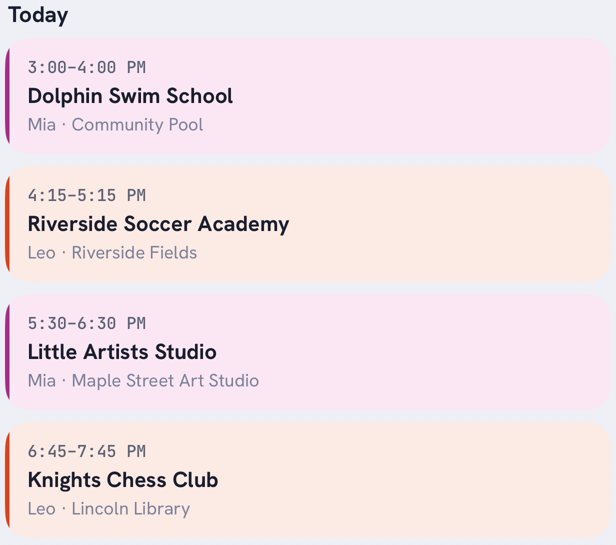
In Kidbud you'd add the swim class once, give Monday's drop-off to yourself and the pickup to your partner, and only the assigned driver gets the Leave Now reminder. Our guide on when to leave for drop-off and pickup covers the timing side, and the after-school routine by age shows where a 4:45 class fits around snack, homework and bedtime.
How Kidbud helps with swim season
Kidbud won't teach anyone to swim, and it can't watch the pool for you. It handles the logistics around lessons: a shared family calendar for every child's classes, one named parent on each drop-off and pickup, and a traffic-aware Leave Now reminder for whoever is driving. You can invite a grandparent who covers Wednesdays, and they'll see the same plan.
Discover recommends local classes matched to each child's interests and adds the one you choose to your calendar. Kidbud doesn't import from Google or Apple calendars, so classes you already have go in by hand. It's a subscription, $59.99 a year or $12.99 a month on iPhone and Android, and one subscription covers everyone you invite to the family.
Twice a week at 4:45, with a name on every drive
Kidbud puts every swim class on the family calendar and tells the assigned driver when to leave.


Frequently asked questions
What age can babies start swim lessons?
Some pools run parent and baby classes from 6 months, but the AAP says there is currently no evidence that infant swim programs for babies under 1 lower drowning risk. Lessons can begin for many children at age 1.
Are swim lessons worth it for toddlers?
For most families, yes. The AAP says water competency and survival skills training through swim lessons can help reduce drowning risk for children ages 1 to 4. Lessons work alongside close supervision, never instead of it.
How many swim lessons does a child need?
There is no set number. The AAP says children need multiple sessions and that you should see gradual but consistent progress. Keep booking sessions while your child is still moving forward.
Group vs private swim lessons: which is better?
Group lessons cost less and suit kids who are comfortable in the water and can wait their turn. Private lessons suit nervous swimmers or kids who need to catch up. Starting private and moving to group later is a sensible path.
How much do swim lessons cost?
Prices vary widely by area and format. As one example, the Hamilton Family Y in Chattanooga charged members $80 and non-members $120 for 8 weekday group lessons in August 2026. Check your local Y or parks department.