
Short answer
A good after-school routine runs in the same order most days: snack, play, homework or reading, dinner, wind-down, bed. Set bedtime first, since the CDC says children 6 to 12 need 9 to 12 hours of sleep, then fit the afternoon around it. Younger kids get more play and an earlier night. On activity days, shrink the middle and keep bedtime.
What should an after-school routine include?
Snack, play, homework, dinner, wind-down, sleep. The order matters more than the exact times, because a child who knows what comes next has less to argue about. Give play a real slot of its own. The American Academy of Pediatrics calls play brain building and a buffer against stress, and its 2018 report recommends that doctors write a prescription for play.
The exact order is our judgment. We don't know of good research comparing snack-then-homework with homework-then-play, and kids differ a lot here.
Screens don't count as that play, though. The AAP says real-time social interaction and play beat digital media for learning, and that electronic media takes away time for real play, indoors or out.
Most routines hold up fine on a quiet Monday. They fall apart on the Thursday with a 4:15 class across town and nobody sure who's driving. (That day is the one we built Kidbud for.)
What time should bedtime be for school-age kids?
Work backward from wake-up. The CDC recommends 9 to 12 hours of sleep for children 6 to 12, and 10 to 13 hours, naps included, for 3- to 5-year-olds. Teens 13 to 17 need 8 to 10. If your kindergartner wakes at 6:45, lights out by 8:45 is the absolute latest for 10 hours, and we'd aim well before that.
| Age | CDC recommended sleep | Latest lights-out for a 6:45 a.m. wake-up |
|---|---|---|
| 3 to 5 | 10 to 13 hours, including naps | 8:45 p.m. |
| 6 to 12 | 9 to 12 hours | 9:45 p.m. |
| 13 to 17 | 8 to 10 hours | 10:45 p.m. |
Treat those as floors. A 7-year-old asleep at 9:45 and up at 6:45 is technically inside the range and will probably be a wreck by Friday.
What is a good after-school routine for a 5 or 6 year old?
Short, and mostly play. Kindergartners usually come out of school tired and hungry, so lead with food and downtime, keep reading together to ten minutes or so, and get dinner and bath done early enough to protect a 7:30 bedtime. We'd keep it to one or two activities a week at this age, and leave the other afternoons open.
The right-hand column is the same day with a 4:30 swim class, assuming the pool is about 15 minutes away.
| Time | Regular day | Activity day (swim 4:30 to 5:00) |
|---|---|---|
| 3:00 | Home, snack and a drink | Home, snack and a drink |
| 3:30 | Play, outside if you can | Shorter play at home |
| 4:10 | Play continues | Leave for the swim drop-off |
| 4:45 | Reading together, about 10 minutes | Class ends at 5:00, pickup |
| 5:30 | Dinner | Dinner, made the night before |
| 6:30 | Bath, pajamas, books | Bath, pajamas, books (the reading goes here) |
| 7:30 | Lights out | Lights out, same as always |
If you make a kindergarten routine chart, draw it. Plenty of five-year-olds can't read a word chart yet.
What is a good after-school routine for ages 7 to 9?
Homework shows up, so give it a fixed slot. Most 7- to 9-year-olds do better with a snack and some play first, then homework at the same time every day, then dinner. Bedtime can drift to 8:00 or 8:15, which still gives about ten and a half hours before a 6:45 wake-up, comfortably inside the CDC's 9 to 12.
| Time | Regular day | Activity day (soccer 5:00 to 6:00) |
|---|---|---|
| 3:15 | Home, snack | Home, snack |
| 3:45 | Play or time with friends | Homework first |
| 4:30 | Homework, same spot every day | Change, find the cleats |
| 4:40 | Homework continues | Leave for the practice drop-off |
| 6:00 | Dinner | Practice ends, pickup |
| 6:20 | Free time | Dinner |
| 7:15 | Bath or shower, reading | Shower, reading |
| 8:00 to 8:15 | Lights out | Lights out, 15 minutes late at most |
Notice what moved. Play got squeezed on the activity day, and that's fine once or twice a week. Every day, and it isn't.
What is a good after-school routine for ages 10 to 12?
Hand over more of the plan. Tweens can own a checklist, start homework without a reminder, and handle a busier activity load, but they still need 9 to 12 hours of sleep by the CDC's numbers. Screens are where this age loses the evening, so we'd agree on when screens end before the routine starts, not at 8:55 that night.
| Time | Regular day | Activity day (practice 6:00 to 7:30) |
|---|---|---|
| 3:30 | Home, snack | Home, snack |
| 3:45 | Downtime, outside or with friends | Homework straight away |
| 4:45 | Homework, on their own | Homework finishes, pack the bag |
| 5:15 | Homework continues | Early dinner |
| 5:40 | Free time | Leave for the practice drop-off |
| 6:15 | Dinner | At practice |
| 7:30 | Free time, screens off by 8:00 | Practice ends, pickup |
| 8:00 | Shower, reading in bed | Shower, quick reading |
| 9:00 | Lights out | Lights out |
How do you handle activity days with drop-offs and pickups?
Decide the logistics the night before: who does the drop-off, who does the pickup, and what's for dinner. Activity days break at the edges, when class ends at 5:15, dinner was meant to be at 5:30 and nobody owns the drive home. Move homework before the class rather than cutting it, eat something easy, and hold bedtime where it is.
- Look at the whole week together on Sunday evening. Our guide to splitting drop-offs and pickups covers the patterns couples use.
- Put one parent's name on every drop-off and every pickup.
- Work out leave times from traffic, not class start. See what time to leave for drop-off or pickup.
- Pack the bag the night before. The cleats are always in the other car.
- Plan the easiest dinner of the week for the busiest day.
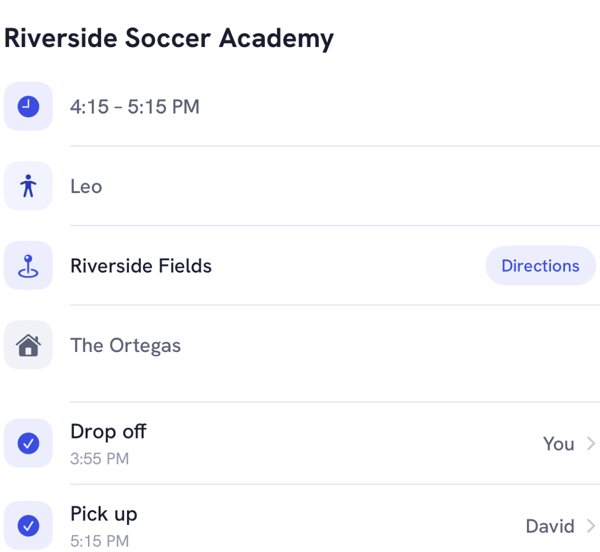
Assign Thursday's 5:15 pickup to your partner in the app, and the Leave Now reminder goes to them, not you. If two activity days land back to back, the week view shows it before Monday does.
Should you use an after-school routine chart?
For kids under 8, yes, and make it pictures. Five or six small drawings in order, snack, play, reading, dinner, bath, bed, taped at their eye level, do more than a parent repeating the next step. Older kids can use a written checklist they tick off themselves. Kidbud doesn't do chore charts or lists, so for this part a sheet of paper on the fridge is honestly the better tool.
Keep the chart to the routine itself. Activities change every season, and rewriting the fridge in marker each September gets old fast.
How Kidbud fits into the routine
Kidbud only covers the activity side of the afternoon. Snacks and homework are still yours. What it does: every child's classes go on one shared family calendar with day, week and month views and a filter by child. Each drop-off and pickup has one parent's name on it, and that driver gets a traffic-aware Leave Now reminder, timed "just as I leave", with a 20-minute heads-up, or at times you pick.
You can invite a spouse, a caregiver or the grandparent who does Wednesdays (assign Grandpa the Wednesday pickup and the leave reminder goes to his phone, not yours). Kidbud doesn't import from Google or Apple calendars, and there's no chore list or meal planner. It runs on iPhone and Android, at $59.99 a year or $12.99 a month for the whole family.
Keep bedtime when Thursday has a 5:15 pickup
Kidbud puts a name on every drop-off and pickup and tells the driver when to leave.


Frequently asked questions
What is a good after school schedule for kids?
Snack, downtime or play, homework or reading, dinner, then a fixed wind-down to bedtime, in the same order most days. Set bedtime first using the CDC's 9 to 12 hours of sleep for ages 6 to 12, and fit everything else before it.
What is a good after school routine for a 6 year old?
Mostly food and play. A snack straight away, a long stretch of play, a few minutes of reading together, an early dinner, then bath and books with lights out around 7:30 or 8:00.
What should an after school routine for kindergarten include?
A snack, plenty of unstructured play, a short shared reading time, dinner, and a calm bedtime routine. Keep the order the same every day, and add no more than one or two activities a week.
How do you keep a routine on activity days?
Keep the order and the bedtime, and shrink everything in between. Move homework before the class, plan an easy dinner, and decide the night before who does the drop-off and who does the pickup.