
Short answer
Most music schools start private piano lessons at about 5, and violin at 5 to 7. Guitar and drums usually wait until 6 or 7, woodwinds until about 8, and private voice lessons until 7 to 10. Under 5, a group music class tends to work better than private lessons. These are teacher guidelines, not rules: a keen 6-year-old beats a reluctant 9-year-old.
What age should a child start piano lessons?
Five is the most common answer. Santa Monica Music Center won't start private piano lessons before 5, because by then kids have longer attention spans and hold on to what they learn. Off the Wall School of Music also uses 5 as its minimum, with a few teachers who'll take a 4-year-old. Younger than that, most schools point you to a group class instead.
The same Santa Monica school is blunt about 3- and 4-year-olds: private lessons generally don't work at that age, because the child hasn't been in a formal classroom yet and learns better through games. A preschool music class builds the basics for later.
Age is only half of it. Our own rough test for a 5-year-old has two parts. They can sit through a 30-minute lesson without melting down. And someone at home can sit beside them for ten minutes of practice most days, which is a bigger ask of the parent than of the kid (the lesson itself is the easy half).
It's also a weekly drive, every week, for years if it sticks. (That's the part we built Kidbud for: the lesson goes on the family calendar with one parent's name on the drop-off and pickup.)
What is the best age to start music lessons for each instrument?
The instrument sets the age more than the child does, because each one asks something different of a small body. Piano and violin can start around 5, once a child can focus through a lesson. Guitar and drums usually wait until 6 or 7, partly for hand size and reach. Woodwinds start around 8 for lung capacity, and private voice lessons often wait until 7 to 10.
This is what two US music schools publish, side by side. Treat it as common teacher guidance, not law.
| Instrument | Santa Monica Music Center | Off the Wall School of Music | Why |
|---|---|---|---|
| Group music class | 3 to 4 | Not listed | Preschoolers learn better through play |
| Piano | 5 | 5 (4 with some teachers) | Attention span and memory |
| Violin, viola, cello | Violin from 5 | 7 | Some teachers start at 3, but the school sees better progress from 5 |
| Guitar, bass, ukulele | Not listed | 7 | Not stated |
| Drums | About 6 | 7 | Reaching the pedals and cymbals |
| Flute, clarinet, saxophone | 8 and up | Not listed | Lung capacity, and the size of a saxophone |
| Voice | 10 for private lessons | 7 | Breathing technique, and the vocal cords and lungs still developing |
Drums have a workaround. Santa Monica Music Center notes that younger kids can start on a snare drum or practice pad, learning stick control before they can reach a full kit.
What age should a child start violin?
Usually between 5 and 7. Santa Monica Music Center accepts violin students from 5 and says some teachers start children as young as 3, though in its experience the most productive learning comes at 5 or older. Off the Wall School of Music sets 7 as its minimum for violin, viola and cello.
Our opinion: the early start works best when a parent is willing to be part of practice every day. A 4-year-old won't tune a violin or remember what the teacher said on Tuesday. If that daily half hour isn't realistic in your house right now, waiting until 6 or 7 costs very little.
What age should kids start guitar lessons?
Around 7 is the common minimum. Off the Wall School of Music lists 7 for guitar, bass and ukulele alike. Guitar asks a lot of small hands: pressing a string hard enough to ring cleanly takes finger strength, and the first weeks are sore for adults too. A 5-year-old desperate to play is probably better off messing about on a ukulele at home first.
If your child wants guitar because of a band they love, that's a great reason. Tell the teacher. Learning one song they actually know in the first month does more for practice than a term of exercises.
Are music lessons worth it?
As music, yes. As a brain booster, probably not. A 2020 meta-analysis by Giovanni Sala and Fernand Gobet pooled 54 studies covering nearly 7,000 children and found that once study quality was accounted for, music training had essentially no effect on cognitive skills, reading or math. Small positive effects turned up only in studies that didn't randomize children or use an active comparison group.
Not everyone agrees. Two other researchers, Emmanuel Bigand and Barbara Tillmann, reanalyzed the same data and argued for a small but real effect. Either way, nobody in this debate is claiming big gains, and the same Sala and Gobet team found the same pattern for chess (see our guide on whether chess is good for kids).
So we'd ignore any studio's "piano makes kids better at math" pitch. Pay for lessons because your kid wants to play the songs they hum in the car, or wants a seat in the school band.
How much do music lessons cost?
We couldn't find a national average we'd trust, so here is one real price list instead. Santa Monica Music Center in California lists single private lessons at $49 to $93, depending on whether it's 30 or 60 minutes, and four-lesson packs at $176 to $332. That works out to roughly $176 to $332 a month for a weekly lesson at that school.
| Option at Santa Monica Music Center | Listed price |
|---|---|
| Single private lesson, 30 or 60 minutes | $49 to $93 |
| Pack of four lessons | $176 to $332 |
| Teacher comes to your home | $103 to $372 a month |
Prices checked October 2026. Santa Monica isn't a cheap place to live, so call a couple of teachers near you before you decide. Instrument rental or purchase comes on top. Our guide to what kids' activities cost puts music next to sports and other classes.
How do you fit weekly music lessons into a busy week?
Treat the lesson as a standing appointment. A 30-minute lesson is a weekly drop-off and pickup that's often too short to go home in between, so one parent usually waits or runs an errand nearby. Pick a slot you can keep all year, and decide who drives each leg before you sign.
- Choose a time that's free every week, not just this month. Moving a lesson midyear means finding a new slot that suits the teacher too.
- Name the driver for both legs. If one parent does the drop-off and waits, that's one person, not two.
- Set practice right after school or right after dinner, the same time every day.
- Look again after one term. If it's tears every practice, change the instrument or the teacher before you quit music altogether.
Picture a February Tuesday. The lesson runs 4:30 to 5:00, the drive is 15 minutes each way, and a younger sibling is asleep in the back seat. Going home makes no sense, so someone sits in the parking lot for half an hour. Every week. That's fine, as long as everyone agreed it's the plan before the term started.
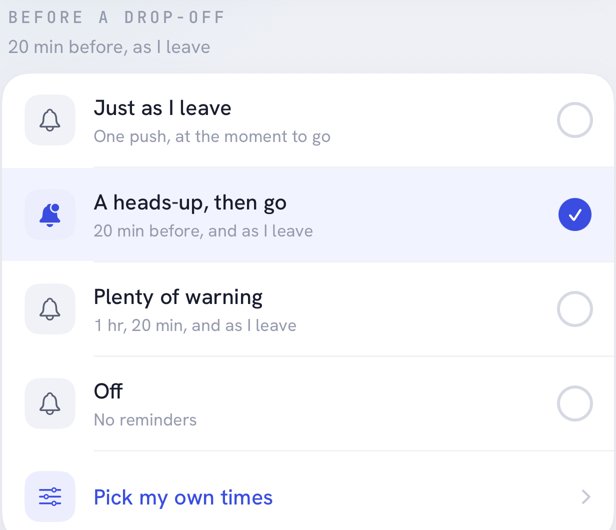
In Kidbud, a Tuesday 4:30 piano lesson sits on the shared calendar. You'd give the drop-off to whoever's home first and choose a 20-minute heads-up for it, and the pickup reminder can be timed separately.
How Kidbud helps with weekly lessons
A weekly lesson is exactly the kind of thing we made Kidbud for: same time, same place, and somebody has to drive. In Kidbud every lesson has a drop-off and a pickup, each with one parent's name on it, and that driver gets a traffic-aware Leave Now reminder. Discover can suggest local classes from each child's interests, and the one you choose lands on the family calendar.
It won't track practice minutes (a sticker chart on the piano does that better). It also doesn't sync with Google or Apple calendars or set up carpools with other families. Kidbud runs on iPhone and Android for $59.99 a year or $12.99 a month, and one subscription covers the spouse, caregivers or grandparents you invite.
Never miss the 4:30 piano lesson
Kidbud puts every lesson on one family calendar and tells the right parent when to leave.

Frequently asked questions
What is the best age to start music lessons?
For private lessons, around 5 for piano and 5 to 7 for violin, with guitar and drums closer to 7. Before 5, music schools generally suggest a group music class instead, because very young children learn better through play than in a one-to-one lesson.
Can a 4-year-old take piano lessons?
Some can. Most schools set 5 as the minimum for private piano, though some teachers take 4-year-olds. A group music class is usually the better first step at 3 or 4.
Is 10 too late to start an instrument?
No. Some music schools don't start private voice lessons until 10, and woodwinds like flute and saxophone usually begin at 8 or later. A 10-year-old who chose the instrument themselves often practices more willingly than a 5-year-old who didn't.
How much do music lessons cost per month?
It varies widely by city and teacher. As one example, Santa Monica Music Center in California sells four-lesson packs for $176 to $332, depending on lesson length, so weekly lessons there cost roughly that much a month.
Sources
- Santa Monica Music Center, lessons, prices and starting ages by instrument
- Off the Wall School of Music, how old does my child need to be to start lessons?
- Sala and Gobet, Cognitive and academic benefits of music training with children: a multilevel meta-analysis, Memory and Cognition, 2020
- Bigand and Tillmann, Near and far transfer: is music special? Memory and Cognition
- Sala and Gobet, Does far transfer exist? Negative evidence from chess, music and working memory training, 2017