
Short answer
Yes, as a hobby. Chess costs almost nothing, and it's something a kid can get properly good at. The claim that it makes children smarter is much weaker: studies show modest math gains, but almost none used a fair comparison group, and a large randomized trial in England found no effect on test scores. Most kids are ready for a real class between 6 and 8.
What does the research say about chess for kids?
The study most people quote is a 2016 meta-analysis by Giovanni Sala and Fernand Gobet, which pooled 24 studies of chess taught in schools. Children who took chess did better than comparison groups in math, in general cognitive ability and, by a smaller margin, in reading. The effects were modest, and they got bigger the more hours of chess the kids had.
| Outcome | Average effect size | Roughly means |
|---|---|---|
| Math | 0.38 | Small to moderate |
| Overall cognitive ability | 0.34 | Small to moderate |
| Reading and literacy | 0.25 | Small |
The authors suggested that 25 to 30 hours of chess, about one lesson a week across a school year, was probably the minimum for a meaningful benefit. A six-week after-school taster doesn't get close.
Then the catch. Almost none of the 24 studies compared chess with an active control group, meaning kids who got some other new and interesting activity instead. Children who are excited about a class may try harder at school for a while, whatever the class is. A year later, Sala and his colleagues called it the most serious problem in the field. These are the same researchers whose numbers make chess look good.
Does chess make kids smarter?
Probably not in a way you'd see on a report card. A large randomized trial in England gave about 1,965 nine- and ten-year-olds a year of chess lessons and compared them with about 1,900 classmates who had none. When the kids sat national tests a year after the lessons ended, the two groups did not differ in math, literacy or science.
To be fair, Sala and his colleagues argued that trial had weak spots: nothing was measured straight after the lessons, and about half the kids were already scoring above 75% in math, which leaves little room to show a gain. Their own conclusion was that the evidence can't establish the benefits either way.
Their later work was blunter. In 2017 Sala and Gobet looked at chess, music and memory training together and found that the better designed a study was, the smaller its effect. Skills learned in one area rarely carry over into general intelligence or grades.
Our read: chess makes kids better at chess. That's a perfectly good reason to do it. So is having something to play with a grandparent, or learning to lose without sweeping the pieces off the table. We'd just be wary of any class that sells itself as a way to raise math scores.
What age should a child start chess?
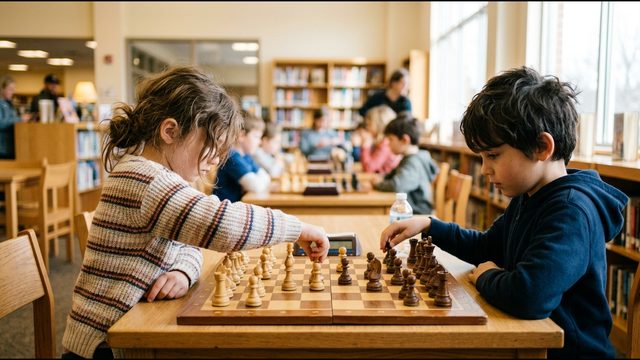
Most chess teachers put the sweet spot at 6 to 8. A 5-year-old can learn how the pieces move through mini-games at home, a few minutes at a time. A proper class with full games works better once a child can sit still for a while and lose without a meltdown. For group teaching, 8 is often treated as the reference age.
This table is our summary of common teacher advice, not a rule. Some 5-year-olds are ready and some 9-year-olds aren't.
| Age | What tends to work | Class? |
|---|---|---|
| 4 to 5 | One piece at a time through mini-games, at home | Usually too early |
| 6 to 7 | Full rules, short games, simple puzzles | A beginner class, if they're asking for it |
| 8 to 10 | Basic tactics, writing down moves, regular games | Most classes and school clubs |
| 11 and up | Tournaments, online play, coaching | A club or a coach |
Readiness beats the birthday. The International Chess Club piece we link below looks for comfort with turn-based games and the patience to sit and concentrate. We'd add how your kid takes losing at Uno. It also warns against rushing into full games too early, because a child who decides chess is boring at five may not come back to it. (Finding a beginner class nearby is the reason Discover exists in Kidbud: it suggests local classes matched to each child's interests. It can't tell you whether the teacher is any good. A trial session can.)
Is chess good for kids with ADHD?
The evidence is thin. The study usually quoted is a 2016 pilot from Madrid: 44 children aged 6 to 17 with ADHD did an 11-week chess program, and their parents rated their symptoms lower afterwards. There was no control group, and the scores came from parents who knew their child had done the program. The authors themselves said the results should be read with caution.
That doesn't make chess a bad fit. Some kids with ADHD love it and some find 45 minutes at a board miserable, same as every other kid. Treat it as a hobby to try, not a treatment, and keep the treatment conversation with your child's doctor. Say your 8-year-old will stare at a tactics puzzle for twenty minutes but is under the table ten minutes into a full game. That's a kid for a puzzle-based class with short rounds, not a club night of long games. (We don't know of a controlled trial that settles the ADHD question either way.)
Chess class or chess club: which is better for kids?
For a beginner, a class. A teacher works through the rules and basic tactics in order, so a 7-year-old isn't just losing to 10-year-olds every week. A club suits kids who already know how to play and mostly want games against other kids. Plenty of children do a season or two of classes and then move to a club.
Before you sign up, ask:
- How long is each session, and how many weeks does the term run?
- Are kids grouped by level, or only by age?
- How much of the time is real games versus puzzles?
- Can your child try one session first?
- What's the total cost for the term, including any tournament fees? (Our guide to what kids' activities cost helps you compare.)
Whichever you choose, it's a weekly drop-off and pickup, often at an awkward hour. A 6:45 library club on Thursdays sounds easy until it lands on the same evening as soccer across town. If chess is going on top of other activities, read how many extracurricular activities a child should do first.
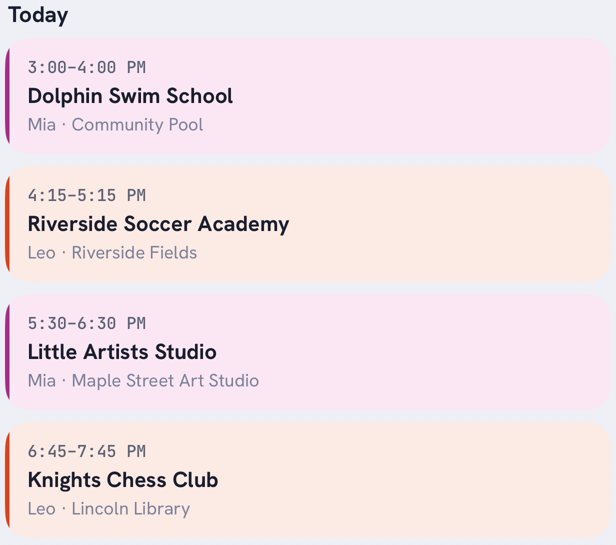
In Kidbud you'd give the 6:45 drop-off to one parent and the 7:45 pickup to the other, and each of them gets their own leave reminder.
How Kidbud helps with chess classes
We built Kidbud around the driving, because that's the part of a weekly class that actually goes wrong. Discover suggests local classes matched to each child's interests and puts the one you choose on the shared family calendar. After that, each drop-off and pickup carries one parent's name, and the traffic-aware Leave Now reminder goes to that parent.
Two honest gaps. Kidbud doesn't sync with Google or Apple calendars, so the rest of your week goes in by hand, and it doesn't set up carpools with other families. It's on iPhone and Android, priced at $59.99 a year or $12.99 a month, and one subscription covers everyone you invite (the grandparent who does Thursday chess included).
Find the chess class, then cover the Thursday drive
Kidbud suggests local classes for each child's interests and tells whoever's driving when to leave.


Frequently asked questions
What age should a child start chess?
Most chess teachers suggest 6 to 8 for a structured class. Children of 4 or 5 can start with mini-games at home that teach one piece at a time. Readiness matters more than the birthday: taking turns, sitting still for a while and coping with a loss.
What are the benefits of chess for children?
As a hobby, chess gives kids practice at thinking a few moves ahead and at losing gracefully, and it costs very little to keep up for life. Studies of school chess programs found modest gains in math, but the better-designed studies found little or no effect on grades.
Is chess good for kids with ADHD?
It can be a good hobby, but there is no strong evidence that it treats ADHD. The study most often cited was a small pilot with 44 children, no control group and results reported by parents. Try chess as an activity, and keep treatment decisions with your child's doctor.
How often should kids take chess classes?
Once a week is typical. It also lines up with the research: a 2016 meta-analysis suggested 25 to 30 hours, about one lesson a week for a school year, as the likely minimum before any academic benefit showed up.
Should my kid join a chess club or take chess classes?
Beginners usually do better in a class, where a teacher builds skills in order. Once your child knows the rules and wants real games against other kids, a club is the better fit.
Sources
- Sala and Gobet, Do the benefits of chess instruction transfer to academic and cognitive skills? A meta-analysis, Educational Research Review, 2016
- Sala, Foley and Gobet, The effects of chess instruction on pupils' cognitive and academic skills, Frontiers in Psychology, 2017
- Sala and Gobet, Does far transfer exist? Negative evidence from chess, music and working memory training, 2017
- International Chess Club, What is the best age to teach chess to children?
- Blasco-Fontecilla and others, Efficacy of chess training for the treatment of ADHD: a prospective, open label study, Revista de Psiquiatría y Salud Mental, 2016