
Short answer
Start from what your child already does for fun, not from what their friends are signed up for. Match the format to their temperament, book a trial class before paying for a term, and check the drive: a class 25 minutes away at 4:15 is a very different commitment from one at the school. Pediatricians also advise trying several activities rather than specializing early.
How do you choose the right activity for your child?
Start with what your kid does on a free Saturday when nobody is organizing them. That is the most honest signal you'll get. A child who spends three hours on a Lego spaceship, or kicks a ball against the garage until dinner, has already told you something. Pick a class that gives them more of that, then let them choose between two options so it feels like theirs.
The common mistake is starting from the other end: a friend's mom mentions a great gymnastics place, there's a spot on Wednesdays, and three weeks later your kid is crying in the car. Interest first. The convenient Wednesday slot can wait.
These pairings are our own suggestions, not research. They're a starting point for a conversation with your kid.
| If your kid spends free time… | Activities worth trying |
|---|---|
| Building forts, Lego, taking things apart | Robotics, coding club, woodworking |
| Drawing on everything | Art class, pottery, animation |
| Running, climbing, never sitting down | Soccer, gymnastics, swimming, martial arts |
| Making up stories and voices | Drama, improv, a writing club |
| Singing along to everything | Choir, music lessons |
| Board games and puzzles | Chess club, math circle |
(We built Kidbud's Discover on the same idea: it starts from what each child is into and suggests local classes, instead of every listing within ten miles.)
What activities do most kids do?
Sports are the most common, then lessons, then clubs. In the Census Bureau's look at 2014 survey data on school-age children, 42% played sports, 30% took lessons, and 28% belonged to clubs. Only 9% did all three. So a child doing one or two things is completely normal, not behind.
| Type of activity | Share of school-age kids (2014) |
|---|---|
| Sports | 42% |
| Lessons | 30% |
| Clubs | 28% |
| All three | 9% |
We'd love numbers newer than 2014, but this was the most recent Census breakdown we found. The same report found that kids living in poverty took part less in all three categories. Cost is a real filter, and our guide to what kids' activities cost has numbers by sport.
What activities are good for shy kids?
Look for small groups and activities where kids work side by side rather than perform in front of each other. Art, swimming lessons, chess, coding and martial arts all let a shy child take part without being the center of attention. A class where they already know one other kid helps more than almost anything else you can arrange. Big team tryouts can wait.

This is judgment, not science, and you know your kid better than we do. Two things we'd try. Arrive ten minutes early to the first session so they can meet the teacher before the room fills up. And don't make them introduce themselves to the group if they don't want to.
Shy isn't the same as uninterested. Plenty of quiet kids love the stage once they've got a script to hide behind.
Should kids specialize in one activity?
Not before puberty, according to the American Academy of Pediatrics. Its advice is to encourage a variety of sports, because kids do better when they try many activities before puberty and are less likely to drop out when they play more than one. It also points out that nearly 70% of US kids drop their favorite sport before age 13, and links burnout to single-sport specialization.
The AAP adds three practical limits for sports: wait until about age 6 for organized sports, keep weekly training hours below the child's age in years, and plan for one or two rest days a week and two to three months off across the year. For a 9-year-old, that's under nine hours a week.
If you're wondering how many activities is too many, we wrote a whole guide on how many extracurricular activities a child should do.
How do you try an activity before committing?
Ask for a trial class, and if there isn't one, ask whether you can watch a session. One visit tells you more than any website: whether the teacher learns names, and how much of the hour kids spend standing in line for a turn.
- Book the trial for the exact day and time you'd actually attend, so you test the drive too.
- Watch the last ten minutes, not just the start.
- In the car, ask what the best part was. A specific answer is a good sign.
- Wait a day before signing up. If they bring it up again on their own, that's your answer.
- Once you commit, commit for the term, and agree on that with your kid before the first class.
How do you find kids activities near you?
Start close to home and close to school. Your school's flyers and after-school programs, the public library, the parks and recreation department and other parents at drop-off and pickup will cover most of what's nearby. A search for the activity plus your town fills in the rest. Then check the drive before you look at anything else.
Distance matters more than parents expect, because every session is two drives. Say your daughter's dance class is twice a week for a ten-week term. That's 20 drop-offs and 20 pickups. If the studio is 25 minutes away and you go home in between, each class costs you four 25-minute drives, which adds up to more than three hours behind the wheel a week.
| Class twice a week | 5 minutes away | 25 minutes away |
|---|---|---|
| Driving per session (home in between) | 20 minutes | 100 minutes |
| Driving per week | 40 minutes | 3 hours 20 minutes |
| Over a ten-week term | About 7 hours | About 33 hours |
A slightly less exciting class five minutes away often wins. Before you sign up, decide who does each drop-off and pickup, and check it against your work and your other kids' schedules.
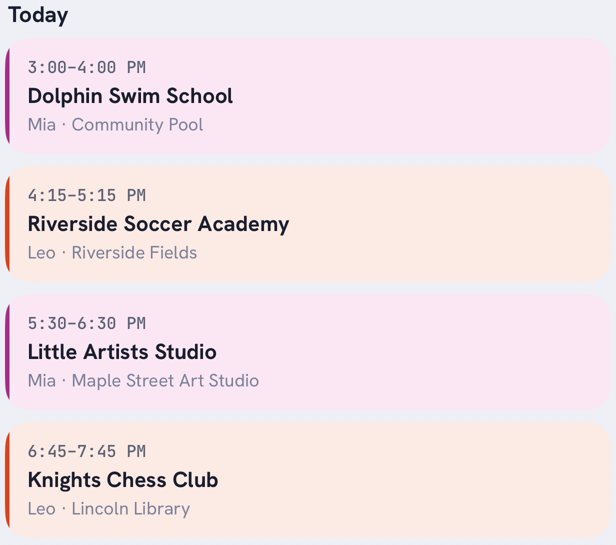
In Kidbud, a class you add from Discover lands on the same calendar as everything else, and the filter by child shows one kid's week at a glance.
How Kidbud helps you choose and keep up
Kidbud covers both halves of this guide: finding the class, then living with it. Discover recommends local classes matched to each child's interests and adds the one you pick to the shared calendar. After that, every drop-off and pickup gets one parent's name, and that driver gets a traffic-aware Leave Now reminder. A new activity shouldn't mean a new group text.
Where it falls short: classes you already have go in by hand, because Kidbud doesn't sync with Google or Apple calendars, and it won't organize carpools with other families. It's on iPhone and Android at $59.99 a year or $12.99 a month. One subscription covers everyone you invite, grandparents included.
Find a class that fits your kid, and your week
Kidbud suggests local classes from each child's interests and tells whoever's driving when to leave.


Frequently asked questions
How do I match activities to my child's interests?
Watch what your child does when nobody is organizing them, then look for a class that does more of that. A kid who builds forts all weekend might like robotics or woodworking. A kid who narrates everything might like drama. Then let them pick between two options.
Should I make my child do an activity?
We think a light rule works better than force: your child chooses the activity, and once they start, they finish the term. Pediatricians advise giving kids the freedom to choose activities they enjoy, since fun is the main reason children say they play sports.
What if my child wants to quit after two weeks?
Ask what changed before deciding. Two weeks is often the point where the novelty fades and the work starts. If it's a problem with the group or the coach, fix that or switch. If they simply dislike it, finish the term and choose something else next time.
How far is too far to drive for a kids' activity?
Count the round trips, not the distance. A class 25 minutes away, where you go home in between, means four 25-minute drives for every session. For a twice-weekly class, that is more than three hours behind the wheel each week.