
Short answer
List every recurring job in your kids' schedule, then for each one write down who anticipates it (notices it's coming), who decides, and who actually does it. Our bet: the doing column looks shared and the noticing column doesn't. To fix it, hand over whole rows, so one parent owns a task from the first reminder to the follow-up.
Say spring soccer registration opens on a Monday in January. Somebody has to know that in December. Somebody has to check the cleats still fit, find the birth certificate the league wants, and remember the second payment is due in March. The parent who drives to practice is visible. The parent who knew practice existed usually isn't.
What is the mental load in a family?
The mental load is the thinking work behind running a household: noticing what's coming, working out the options, deciding, and keeping an eye on it afterwards. It's hard to see because there's nothing to watch. Nobody sees you remember that swim moves to Thursdays in November. With kids' activities, it's mostly calendar work, and that is where it piles up.
The numbers on who carries it are lopsided. In a 2022 Pew Research Center survey, 78% of mothers with children under 18 who were married or living with a partner said they do more of the managing of their children's schedules and activities. Pew asked a similar question in 2015, and 64% of mothers in two-parent households said they do more of it. (The two surveys didn't ask exactly the same group, so we wouldn't read the jump as a clean trend. We don't know of data that tracks this the same way year after year.)
The same 2015 survey shows a perception gap. Only 31% of mothers said this job was shared equally, while 41% of fathers said it was. We don't think that gap is people fibbing. It's the invisibility problem again: you can't count work you never saw happen.
(We built Kidbud for one slice of this, the who's-driving-today slice. The checklist below is useful with or without it.)
What are the four stages of invisible labor?
Sociologist Allison Daminger interviewed members of 35 couples for a 2019 study in the American Sociological Review. She describes cognitive labor in four parts: anticipating needs, identifying options for filling them, making decisions, and monitoring progress. Women in her study did more cognitive labor overall, and more of the anticipating and monitoring in particular. Decision-making was roughly equal.
| Stage | What it looks like for a kids' class |
|---|---|
| Anticipate | Realizing your seven-year-old will want an after-school class this fall, and that sign-ups open in August |
| Identify options | Finding three swim schools within 15 minutes, with times and prices |
| Decide | Picking Tuesday 4:15 at the closer pool |
| Monitor | Noticing the class moved, the fee is due, or she's stopped wanting to go |
Deciding happens in conversation, so both partners see it and feel involved. Anticipating and monitoring happen alone, usually in the shower or at 11 p.m. Daminger's later dissertation calls them high-burden, low-significance work that stays comparatively invisible, which is about the most accurate description of reading a league email at midnight we've seen.
The kids' schedule mental load checklist
Go row by row and write an initial in each column. We've folded Daminger's "identify options" into Who decides, and "monitor" into Who anticipates, since in practice the person who notices a task coming is usually the one who notices when it goes wrong. Be honest about the defaults, not the exceptions. The one time your partner did picture day doesn't count.
| Task | Who anticipates | Who decides | Who does it |
|---|---|---|---|
| Knowing when class sign-ups open each season | |||
| Researching classes and comparing times and prices | |||
| Choosing which classes each child does | |||
| Filling in registration forms and medical or waiver forms | |||
| Paying fees and remembering installment dates | |||
| Putting every class on the shared calendar | |||
| Deciding who does each drop-off and pickup | |||
| Doing weekday drop-offs and pickups | |||
| Doing weekend games and recitals | |||
| Arranging cover when neither parent can drive | |||
| Tracking schedule changes, cancellations and make-up classes | |||
| Reading the coach's or teacher's emails and group chats | |||
| Checking gear still fits and buying replacements | |||
| Packing the bag (water bottle, shin guards, goggles) | |||
| Washing uniforms in time for the next session | |||
| Snack rotation and volunteer sign-ups | |||
| Picture day, team photos and end-of-season gifts | |||
| Answering birthday party invitations and RSVPs | |||
| Buying and wrapping the birthday present | |||
| Planning your own child's party and chasing RSVPs | |||
| Noticing a child is overloaded or wants to quit | |||
| Planning summer camps and school-break care |
If one initial fills most of the first column, there it is. On paper, finally. Our guide to how many extracurricular activities a child should do may help with the "overloaded" row.
How do you use the checklist together?
Fill it in separately first, then compare. The differences are the useful part, because they show work one of you didn't know was happening. Then pick three to five rows to move, and move them whole: the new owner anticipates, decides and does. Set a date about a month out to check how it went.
- Each of you fills in a copy alone, in about ten minutes.
- Sit down together and compare. Talk only about the rows where you disagree.
- Pick a handful of rows to hand over. Choose recurring ones, not one-offs.
- Write the new owner's name next to each, and put the first instance on the calendar.
- Agree not to remind each other about handed-over rows. That's the hard part.
- Review after a month. Swap anything that isn't working.
Rule five is where this usually fails. If you hand over drop-offs and pickups but still text "don't forget she has swim" at 2:30, you've kept the anticipating and given away only the driving.
How do you split the mental load fairly?
Split by ownership. A row is only off your plate once you've stopped thinking about it, and effort alone doesn't tell you that. That means accepting the other parent's way of doing it, including packing the bag differently or booking the later class. Fair doesn't need to mean 50/50 on every row. It means the noticing work is counted and roughly balanced over a normal month.
A few judgment calls, in our view:
- Give each parent at least one high-anticipation row. Sign-ups and summer camps are good ones, because they need noticing months ahead.
- Drop-offs and pickups are easy to split, but the plan behind them isn't. Whoever owns the plan should own the "who's driving" decision too. Our guide on splitting drop-offs and pickups has three rotation patterns.
- Write things down somewhere you both look. A note only one of you can see is still mental load (yes, that includes the reminder app on your phone).
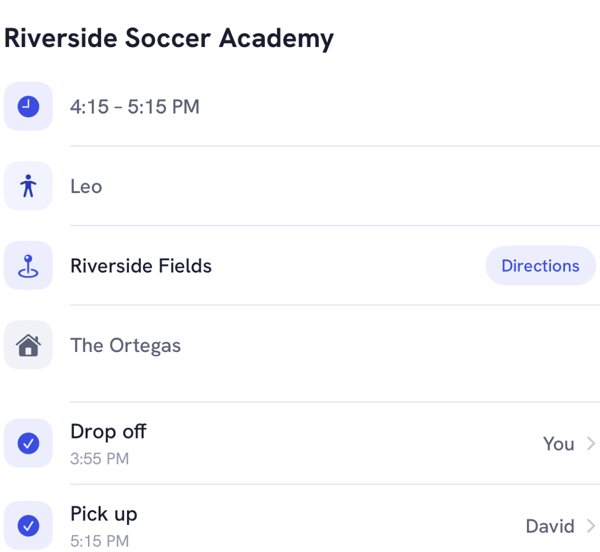
If you don't share a calendar yet, start with how to share a calendar with your spouse. This row is the one we built Kidbud around, so we'll admit some bias: in the app each drop-off and pickup has one parent's name on it, and only that parent gets the reminder to leave. Nobody has to hold it in their head.
Which rows can Kidbud take off your list?
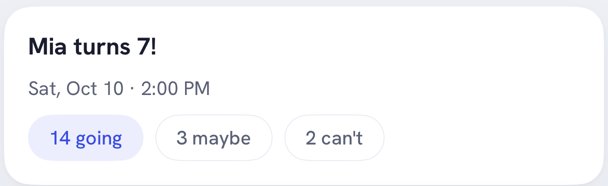
A few, honestly, and not all of them. Kidbud is a shared family calendar for your kids' classes, on iPhone and Android, with a filter by child. Each drop-off and pickup is assigned to one parent, and that parent gets a traffic-aware Leave Now reminder. Birthday invites go out as a link, with RSVPs counted as going, maybe and can't.
It doesn't do chores, shopping lists or meal planning, and it doesn't pull in events from Google or Apple calendars. Forms and payments stay with you. So does the gear bag. It's a subscription ($59.99 a year or $12.99 a month), and one subscription covers everyone you invite, including grandparents.
Take "who's driving?" off the mental load
Kidbud gives every drop-off and pickup one owner, and reminds that parent when to leave.


Frequently asked questions
Is there a mental load checklist PDF?
Use your browser's Print option on this page and choose Save as PDF. The checklist table prints as one list you can mark with initials, one pen color each.
What are some invisible labor examples with kids?
Noticing that registration opens next week, remembering picture day, checking whether the cleats still fit, chasing a birthday RSVP, and keeping track of which parent is doing each drop-off and pickup. The doing is visible. The noticing and tracking usually aren't.
What is the mental load of motherhood?
It's the ongoing work of anticipating, planning and tracking a family's needs, which surveys find falls mostly on mothers. In a 2022 Pew survey, 78% of partnered mothers said they do more of the managing of their children's schedules and activities.
How do you split the mental load?
Hand over whole tasks, not chores. The parent who takes a task also notices when it's due, makes the call and follows up. Fill in the checklist together, move a few complete rows, and review it after a month.
Sources
- Pew Research Center, Facts about U.S. mothers, May 2023 (survey from fall 2022)
- Pew Research Center, Raising kids and running a household: how working parents share the load, November 2015
- Allison Daminger, The Cognitive Dimension of Household Labor, American Sociological Review 84(4), 2019
- Allison Daminger, Thinking Gender: The Cognitive Dimensions of Household Labor, Harvard doctoral dissertation, 2022