
Short answer
Send invitations for most kids' birthday parties three weeks ahead, and set the RSVP date about one week before the party. Go to four weeks for a first birthday, four to six weeks if a venue needs a head count, and six to eight weeks for a big teen party. Around Thanksgiving, December or spring break, add a week.
How many weeks before a birthday party should you send invitations?
Three weeks works for most kids' parties. It's long enough that families haven't filled the Saturday yet, and short enough that nobody forgets. Published advice ranges from two weeks to six, depending on how big the party is and whether a venue is involved, so treat three weeks as the middle of the range rather than a hard rule.
The published advice is all over the place. An invitation-site guide says two to three weeks for children's parties. TulsaKids suggests three to five weeks. Paperless Post goes longer: a month for a party at home and at least six weeks for one at a venue. (Both invitation sites sell invitations, for what it's worth.)
Our view: if you're inviting the whole class to a park, three weeks. If you've put down a deposit and the venue wants numbers, count back from their deadline instead of from the party.
Earlier isn't automatically better. A six-week-old invite for a backyard party gets forgotten. Go too late and you hit the opposite problem. Say your invite lands on a Monday for a Saturday two weeks out: by then that weekend may already hold a soccer game, another kid's party and a grandparent visit, and the family who'd love to come simply got asked second.
Kids' birthday invitation timeline by party type
Use the party type to pick both dates. The send date gives families time to plan, and the RSVP date gives you time to chase replies and order food. The rows combine published guidance with our own judgment, and the right-hand column shows the dates for a hypothetical party on Saturday, November 14, 2026.
| Party type | Send invitations | RSVP deadline | For Sat, Nov 14 |
|---|---|---|---|
| Small party at home or a park | 3 weeks before | 7 days before | Send Oct 24, RSVP by Nov 7 |
| Whole-class party | 3 weeks before | 7 days before | Send Oct 24, RSVP by Nov 7 |
| First birthday | 4 weeks before | 7 to 10 days before | Send Oct 17, RSVP by Nov 6 |
| Venue that needs a head count | 4 to 6 weeks before | 2 days before the venue's deadline | Send Oct 3 to 17, RSVP per venue |
| Near Thanksgiving, December or spring break | Add 1 week | 7 days before | Holiday weekend: send 4 weeks out |
| Sweet 16 or big teen party | 6 to 8 weeks before | 2 weeks before | Send Sep 19 to Oct 3, RSVP by Oct 31 |
| Last-minute party | As soon as you can | 2 to 3 days after sending | Text it, ask for a reply fast |
The first-birthday, venue and Sweet 16 timings come from Paperless Post's guide. The holiday week is from 1Invites. The rest is how we'd do it.
When should the RSVP date be?
Set the RSVP date about a week before the party. That gives you two or three days to chase the families who haven't answered, and a few more to order the cake and pizza with real numbers. If a venue wants a final count on a fixed day, make your RSVP date two days earlier than theirs, because some replies always come in late.
1Invites suggests three to five days before the party. We'd go earlier than that. Five days out is when you want to be ordering food, not still waiting on half the class.
Write the date as a day and a date, "Please reply by Saturday, November 7", not "RSVP ASAP". A real date gets answered. (This is also why Kidbud's party invites sort every reply into going, maybe or can't. The families in none of the three are your chase list.)
If the deadline passes and replies are thin, you're not alone. Our guide on what to do when nobody RSVPs has follow-up messages you can copy.
Should you send digital or paper birthday invitations?
Digital invitations get more replies, because answering takes one tap and the invite can't fall out of a backpack. Paper feels more special, and young kids love handing them out. For a whole class we'd go digital every time. For four close friends, paper is lovely, as long as your school allows it in the classroom.
| Option | Good at | Weak at |
|---|---|---|
| Paper card in the backpack | Feels special, kids love giving them | Gets lost, replies come by text or not at all, many schools restrict it |
| Group text or class chat | Fast, no cost | Replies get buried, and kids who weren't invited may see it |
| Invitation site such as Paperless Post | Polished designs, RSVP tracking, scheduled reminders and messages to guests | One more account, and it sits apart from your family calendar |
| Kidbud party invite | Shared with a link, replies counted as going, maybe or can't, lives next to your kids' schedule | No automatic reminders to guests, so you send your own follow-ups |
Check the school rules before you print anything. Williamson County Schools' elementary handbooks, for one, say individual invitations to private parties may not be handed out during school hours unless every child in the class gets one. Our guide on how many kids to invite covers the whole-class question.
A hybrid works well. Your child hands a paper card to a close friend, and you text the parents a link they can answer from.
What should a kids' birthday invitation say?
A kids' birthday invitation needs the child's name and age, the date with start and end times, the full address, and an RSVP date with a way to reply. Then add what parents actually ask about: whether it's a drop-off party, what to wear, and whether siblings are welcome. Every detail you leave out comes back to you as a text at 9 pm.
- Name and age: "Mia is turning 7".
- Date and both times: "Saturday, November 14, 2 to 4 pm". The end time matters more than people think, because parents plan the rest of the day around it.
- Place, with the full street address and any parking or entrance note.
- RSVP date and how to reply.
- The practical bits: drop-off and pickup times if parents can leave, "wear clothes that can get messy" for a craft party, "siblings welcome" or not, and allergy questions.
Here's wording you can adapt:
Mia is turning 7. Come for cake, crafts and a bouncy castle on Saturday, November 14, 2 to 4 pm, at Maple Grove Park (picnic shelter by the playground). Drop-off party: drop-off at 2, collect at 4. Please reply by Saturday, November 7. Siblings are welcome, just tell us how many.
Keep it short. Nobody reads the third paragraph on an invitation.
What if you're sending invitations late?
Send them anyway, and send them directly. With less than two weeks' notice, skip paper and message each family, say plainly that it's short notice, and ask for an answer within two or three days. Some families will already have plans, so invite one or two more kids than you'd usually want.
That "one or two more" is a guess. We don't know of any good data on what share of invited kids turn up at short notice, so this is judgment, not a formula.
A line like "Sorry for the short notice, we only just booked the place" is enough. Parents get it.
How Kidbud helps with birthday invitations
Kidbud is a family calendar app, and party invites are one part of it. You make a birthday invite with the date, the place and a note, share it with a link by text or the class chat, and each reply is counted as going, maybe or can't. Anyone who isn't in one of those three hasn't answered yet.
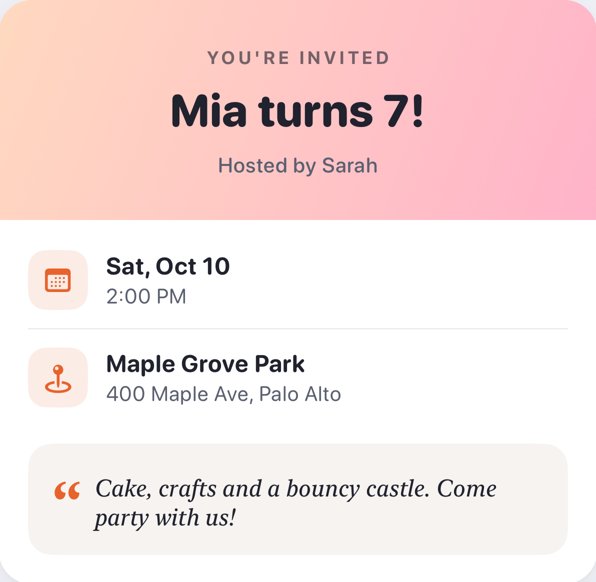
Be clear on what it doesn't do. It won't send reminders to guests or message them for you, so the follow-up texts are still yours. Put the RSVP date and the end time in the note (that's where guests look for details). It's a subscription ($59.99 a year or $12.99 a month on iPhone and Android), and one subscription covers everyone you invite to your family. If a party invite is all you need, a dedicated invitation site may suit you better.
Send the invite, then watch the replies add up
Kidbud counts every RSVP as going, maybe or can't, next to your family's calendar.


Frequently asked questions
How many weeks before a birthday party should you send invitations?
Three weeks is right for most kids' parties at home or in a park. Give four weeks for a first birthday, four to six weeks when a venue needs a head count, and six to eight weeks for a big teen party. Add a week around the holidays.
When should the RSVP date be for a kids' birthday party?
About a week before the party. That leaves time to chase the families who haven't answered and still order food. If a venue wants final numbers on a set date, make your RSVP date two days earlier than theirs.
Is one week enough notice for a kids' birthday party?
It can work for a small party with close friends, but expect a lot of families to have plans already. Send it as a direct message rather than paper, and ask for an answer within two or three days.
Should birthday invitations be digital or paper?
Digital is easier to answer and harder to lose, so you will usually get more replies. Paper is nicer to hold and fine for a small list. Many families do both: a paper card for the child and a link for the parents.