
Short answer
A common rule of thumb is your child's age plus one: four guests for a third birthday, six for a fifth. Nobody studied it. From kindergarten on, we'd pick one of two shapes: a small group of fewer than half the class, or the whole class. The version to avoid is inviting everyone but two or three kids.
What is the age plus one rule for birthday parties?
The age plus one rule says to invite as many children as your child's age, plus one. A three-year-old gets four guests, a five-year-old gets six. It's folk wisdom rather than a finding from a study, and HealthyChildren.org, the American Academy of Pediatrics' site for parents, gives it as the rule of thumb for babies and toddlers specifically.
Kinedu, a baby development app, gives a close cousin: one guest for every year of age. Neither cites research, and we couldn't find any. The idea behind it is sensible, though. Small children get overwhelmed in a crowd, and a toddler party with twelve two-year-olds is mostly crying and juice (and one parent hunting for the spare diapers).
Our take: use it as a ceiling up to about age four, and as a loose starting point after that. By first grade, friendships and class size matter more than arithmetic.
How many kids to invite by age
Under four, stick close to age plus one and keep the party short. From four to seven, the numbers jump, because classmates arrive and parties move to parks and venues. From eight on, kids usually want a few close friends rather than a crowd. The table gives the rule of thumb, what we'd actually plan for, and how long the party should run.
| Turning | Age plus one | What we'd plan for | Party length |
|---|---|---|---|
| 1 to 2 | 2 to 3 | 2 to 4 kids, mostly family friends | Under 90 minutes |
| 3 | 4 | 4 to 6 kids | Under 90 minutes |
| 4 | 5 | 5 to 8 kids | About 90 minutes |
| 5 | 6 | 6 to 12 kids, or the whole class | About 2 hours |
| 6 to 7 | 7 to 8 | 8 to 12 kids, or the whole class | 2 hours |
| 8 to 10 | 9 to 11 | 6 to 10 close friends | 2 to 3 hours |
| 11 and up | 12+ | 3 to 8 friends, often a sleepover or outing | 2 to 3 hours, or overnight |
Party lengths follow HealthyChildren.org: keep toddler parties under 90 minutes, and school-age kids can last about two to three hours. The middle column is our judgment, and your venue or budget may decide it for you.
One thing the table can't show: for preschoolers, parents usually stay. Ten kids can mean twenty-five people in your living room.
Should you invite the whole class to a birthday party?
Invite the whole class if your child is in preschool through about second grade, your budget and space allow it, and invitations would otherwise travel through school. It's the simplest way to make sure nobody is left out. If that's too many, go small instead: fewer than half the class, invited directly through parents, not in the classroom.
That "fewer than half" line isn't ours. Two Rivers Public Charter School in Washington, DC asks families either to invite the entire class or to invite less than half of it, to avoid hurt feelings.
Whole-class parties have a practical upside too. You don't have to decide who's in, and kids from the class who don't usually play together sometimes end up friends. The downside is the head count. With 22 kids invited, you won't know for a while whether 6 or 18 are coming. (That's where a running count of replies helps. Kidbud's party invites count them as going, maybe or can't, so you can watch the number instead of guessing.)
If you go whole class, send the invite three weeks out. Our guide on when to send kids' birthday invitations has the timeline.
What do school policies say about classroom invitations?
The school handbooks we read let you hand out party invitations at school only if every child in the class gets one, and some ask families not to use school for invitations at all. Teachers are often not expected to pass them out either. Check your school handbook before you print anything, because the rule is usually written down somewhere.
| School or district | What the policy says |
|---|---|
| Williamson County Schools (Edmondson Elementary handbook) | Individual invitations to private birthday parties can't be handed out during school hours unless every child in the class gets one. |
| Two Rivers Public Charter School, Washington, DC | Don't hand out invitations at school unless the whole class is invited. Invite fewer than half the class or all of it. |
| South Washington County Schools | Teachers aren't responsible for handing out party invitations, or for sending email invites or RSVP reminders to the class. |
| St. Mary's County Public Schools, Maryland (2013) | Restricted handing out party invitations at school, and suggested PTA phone and email lists for parents instead. |
St. Mary's County's reasoning, as NBC News reported it, was simple: seven invitations in a class of twenty disrupted learning and hurt feelings.
A caveat on the table: we read a handful of handbooks, not a national sample. We don't know of any good data on how many US schools have a rule like this, so treat your own school's handbook as the only one that counts.
So you'll need parents' phone numbers or emails. Ask the room parent or the PTA for a class list. Then a single shareable link does the rest, texted to every parent the same way.
How do you not invite the whole class without hurt feelings?
Keep the party small and keep it out of school. Invite a clear subset, such as four close friends or the kids from a sports team, rather than nearly everyone. Send invitations straight to parents, ask your child not to talk about it in class, and don't post the photos where classmates will see them that week.
- Choose a group with an obvious reason: neighbors, the soccer team, the kids from Saturday art class.
- Avoid "all the girls but one". Two Rivers' fewer-than-half rule exists for exactly this.
- Talk to your child beforehand. Five-year-olds announce things. A gentle "let's keep the party news for home" is worth a try, though no promises.
- If one child in a tight group is left out, invite them. It costs one cupcake.
Do you invite siblings to a kids' birthday party?
It's your call, but say it on the invitation. TulsaKids' etiquette guide tells guests to check with the host before bringing uninvited siblings, which means hosts should make it easy to know. If siblings are welcome, ask families to say how many. If not, a short "invited child only, please" saves an awkward moment at the door.
We'd lean toward welcoming siblings for a park party with toddlers in the mix, because a parent with a baby and a four-year-old often can't come otherwise. For a venue that charges per child, it's fine to say no. Count siblings in your food plan either way (our guide on what to do when nobody RSVPs has a quick method for planning food without firm numbers).
How Kidbud helps with the guest list
Party invites are a small corner of Kidbud, which is mostly a family calendar for classes and their drop-offs and pickups. You set the date, the place and a note (a good spot for "siblings welcome" or "invited child only"), share the invite as a link with the parents on your list, and replies are counted as going, maybe or can't.
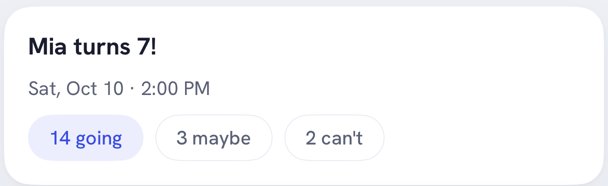
That count is most useful for a whole-class party, where you're waiting on twenty families. It won't send reminders or messages to guests for you, and it doesn't build your class list, so you still need parents' numbers. Kidbud is a subscription ($59.99 a year or $12.99 a month on iPhone and Android), and one subscription covers everyone you invite to your family.
Invited the whole class? Watch the count, not the group chat.
Kidbud counts every reply as going, maybe or can't.


Frequently asked questions
How many kids should you invite to a 5th birthday party?
The age plus one rule of thumb says six. In practice we'd plan for six to twelve, or the whole class if the party is at a park or venue with room and help. We'd want one adult for every four or five kids.
Do you have to invite the whole class to a birthday party?
No. You only need to invite the whole class if you want to hand out invitations at school, which many schools only allow when every child gets one. Otherwise, invite fewer than half the class and send invitations to parents directly.
Is it rude not to invite the whole class?
No, as long as you do it quietly. Invite a small group, send invitations outside school, and avoid inviting everyone except one or two children, which is the version that hurts.
Do you invite siblings to a kids' birthday party?
It is your call, but say it on the invitation. If siblings are welcome, ask families to tell you how many. If not, a short line such as invited child only, please saves an awkward moment at the door.
Sources
- HealthyChildren.org (American Academy of Pediatrics), Playful birthday party ideas and tips for young children
- Kinedu, My young kid's birthday party
- Williamson County Schools, Edmondson Elementary student handbook
- Two Rivers Public Charter School, birthday party policy
- South Washington County Schools, classroom birthday celebrations
- NBC News, Maryland school district restricts hugs, party invitations and cupcakes, 2013
- TulsaKids, Birthday party etiquette for hosts and guests, May 2024